Thursday, December 18, 2014

Detective work: The case of the mystery handknit

Not a lot of posts lately, folks...I've had a pretty wicked case of start-itis, so haven't had a lot of finished projects or new designs to post about. I've also been trying to prioritize work on my dissertation over more "recreational" writing projects. But I wanted to squeeze in at least one last howdy for 2014, and send some holiday-and-new-year best wishes your way!

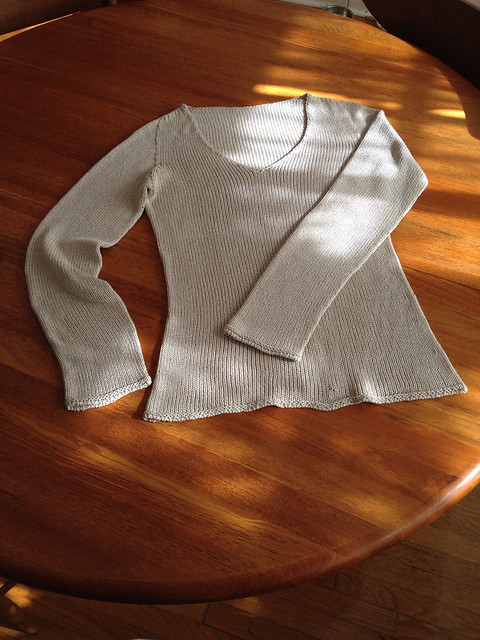
Since my dissertation deals with evidence in a law enforcement context, I'll get around my prohibition on extracurricular writings by framing this post as a bit of detective work--forensic analysis of fiber evidence, to be exact. :-) Here's the body in question; you'll have to imagine the chalk outline for yourself...
image

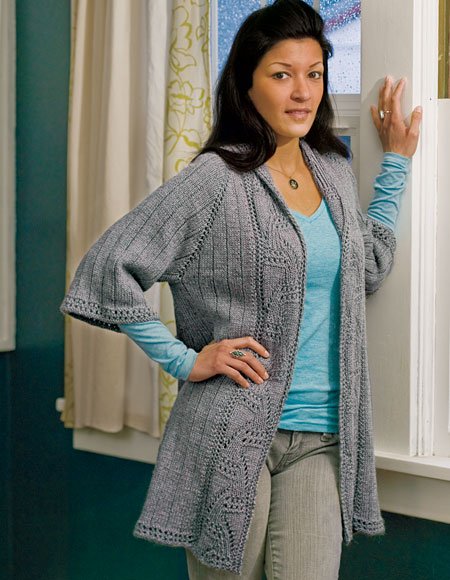
My good friend T. was wearing this sweater when she came over for dinner the other night, and I kept staring at it. It has a strong Eileen Fisher vibe, with its neutral oyster hue, simple lines, and elegant drape. It's far from fancy in construction--mostly stockinette with two simple rows of purled edging at the cuffs and hem--but there were little details, such as the shaping at the waist, shoulder, and neckline, that drew my eye as a knitter. "I think your sweater might be handmade!" I eventually blurted to T. She told me she'd picked it up in a local (LA) thrift shop, twisting around to demonstrate that it didn't have a label in the back neck. When she left that night, she very gamely let me hang onto it for a more detailed forensic analysis, which deepened my initial suspicions.

image

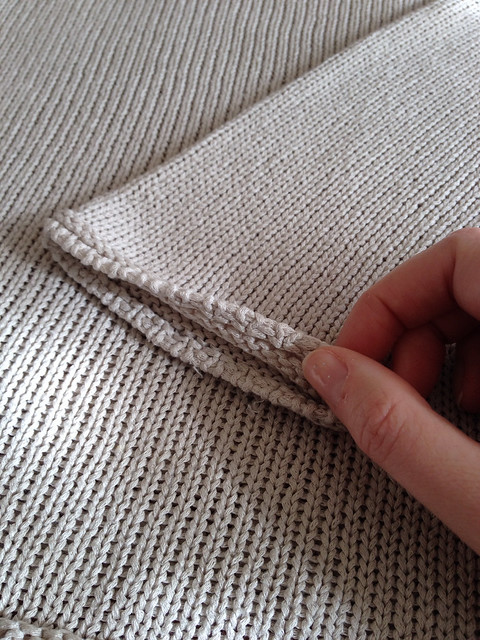
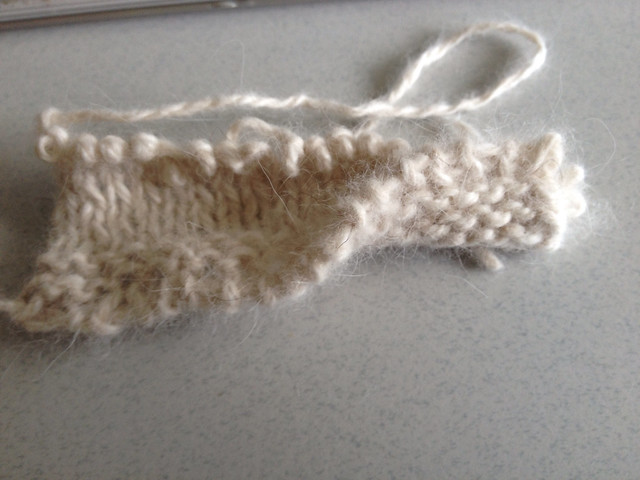
Clue number one: The cast-on. My first impression was that this sweater had been worked seamlessly from the bottom up, so I started by checking out the hems of the body and sleeves, and discovered that they had an unusual-looking cast-on edge. It looked rather like a tubular cast-on, and having done a little bit of trial and error with various methods, I'm now 99% sure that it's the Italian Cast-On with Tubular Set-Up demonstrated in this video tutorial on Liat Gat's KnitFreedom blog. Here's my test version, which is a little fuzzy, but I think you'll find it has pretty much exactly the same appearance:
image

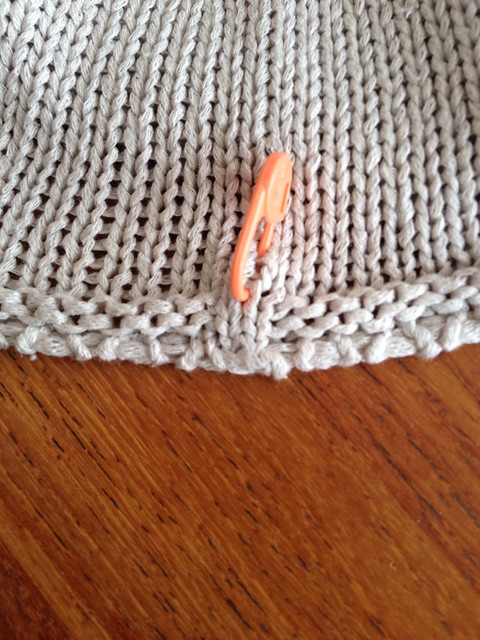
When I went to count the body stitches, I noted that the cast-on edge also had a tell-tale little two-stitch patch of stockinette in the reverse-stockinette rows immediately above the cast-on (probably right at the start of the round). It's not mirrored on the other side of the hem, nor on the cuffs of the sleeves; such asymmetry definitely conveys a handmade feel, as if the knitter was just learning how to use this cast-on method, or perhaps wanted to visually mark the midpoint or beginning of the round.
image

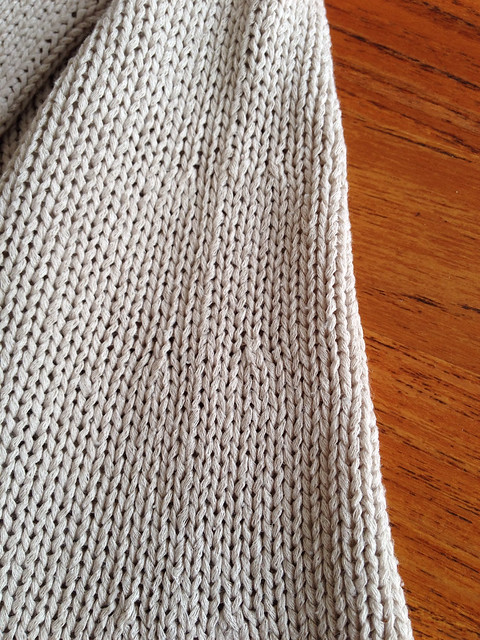
Clue number two: The shaping. Waist shaping on this garment consists of mirrored decreases worked two stitches away from either side of the start and midpoint of the round (as ssk, k4, k2tog).
image

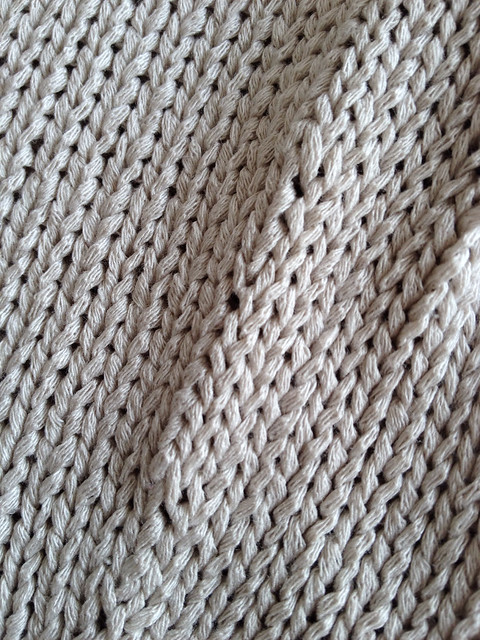
The seamless construction of the body and decreases of this kind aren't unheard-of in machine-knitting, but when it came to the increases, things got interesting...
image

These, my friends, are LIFTED increases--made by picking up the bar between stitches and working it through the back loop. I don't think I've ever seen such an increase in a machine-knitted garment, and it struck me as another distinctly handmade element. The same increases are used in shaping the sleeves, which are also knit in the round with no seam--a further indication of hand-knitting.

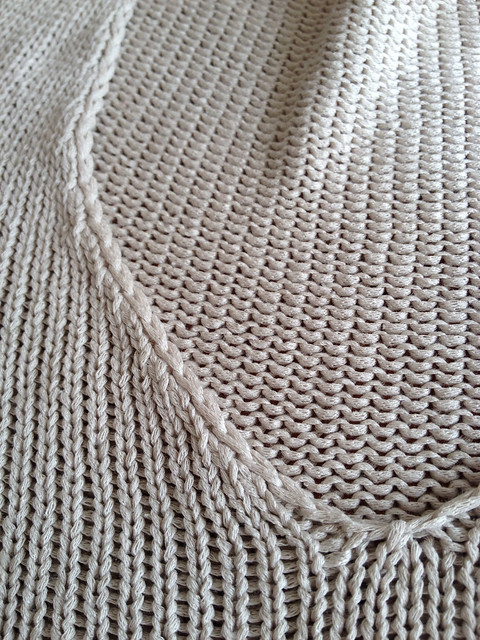
Moving on, there's the neckline. The front and back of the sweater consist of an equal, and even, number of stitches (164 at cast-on, to be exact, or 82 each for front and back).  It looks to me like the shaping for the neckline begins five rows after the sleeves are joined, and was worked as follows:

Set-up to begin working back and forth: k39, k2tog; then turn and sl first st, p to last 2 sts, p2tog. Turn and sl first st, k (with sleeve shaping) to end; turn and sl first st, p to end.

Thereafter: Turn and sl first st, k2tog, k (with sleeve shaping) to last 3 sts, ssk, k1; turn and sl first st, p to end. (Shaping worked on RS rows on both left and right edges of neckline.)

Does it look that way to you, too?
image

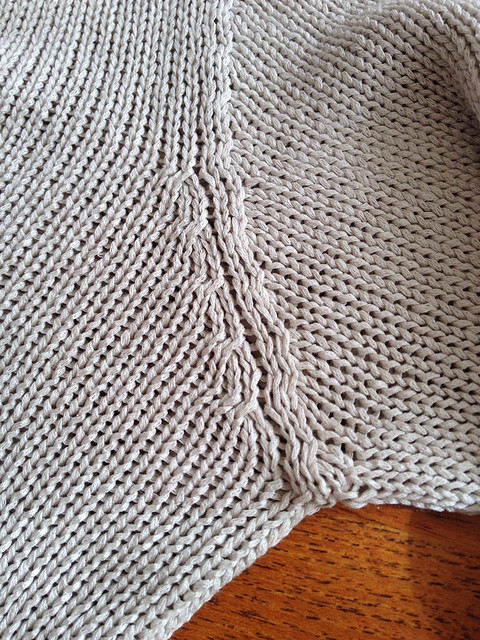
Next there's the shaping where the sleeve is joined to the body and the sleeve cap and underarm shaping are all done seamlessly. These look handmade to me too, for sure.
image

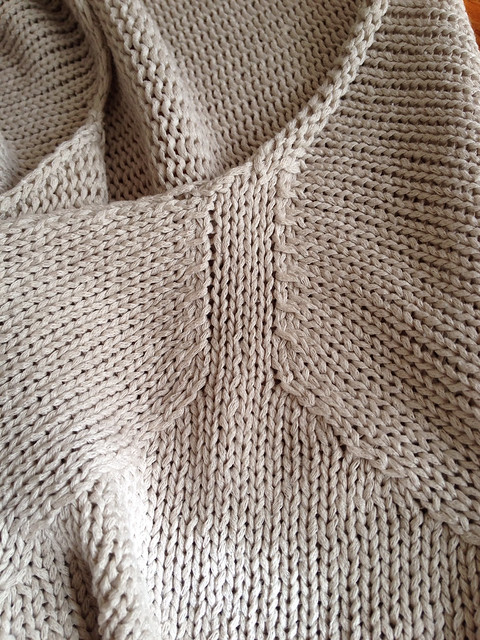
Ditto for the narrow, four-stitch shoulder saddle and associated shaping.
image

Clue number three: The finishing. Here's where the case for handwork is somewhat less definitive in my mind. Even though the whole point of seamless construction is to minimize finishing, you're always going to have a few ends to weave in--not just from the cast-on edges, but also where the sleeves are joined to the body, and wherever you join a new ball or skein of yarn. The way someone weaves in their ends is highly personal, too, so I was really expecting this to be a clincher. (I can't tell you how many discussions I've had in knitting circles about people's preferred methods, time-saving tricks, or confessions that "I just knot the ends together and trim them. If I had to weave everything in I'd never finish anything.") When I turned the garment inside-out to look, though, I found no joins whatsoever in the body--meaning over two square feet of fabric were knitted from a single, continuous length of yarn. Hmm! Unusual, but not impossible, if you have access to big skeins...

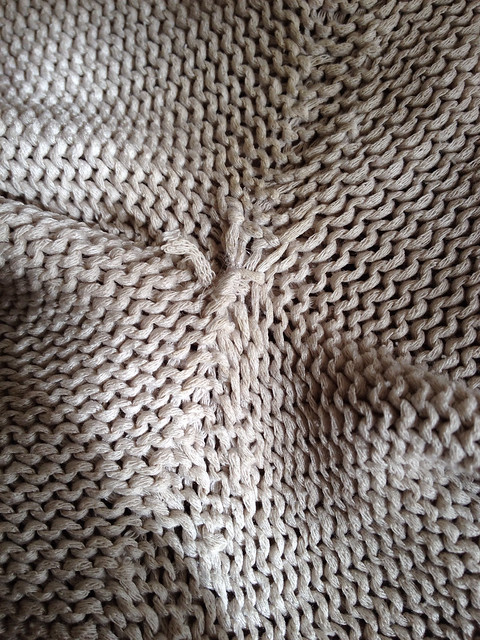
The ends at the underarm joins were really simply and unobtrusively finished, too--in fact, at first glance, I couldn't see how these short little ends were kept so tidy.
image

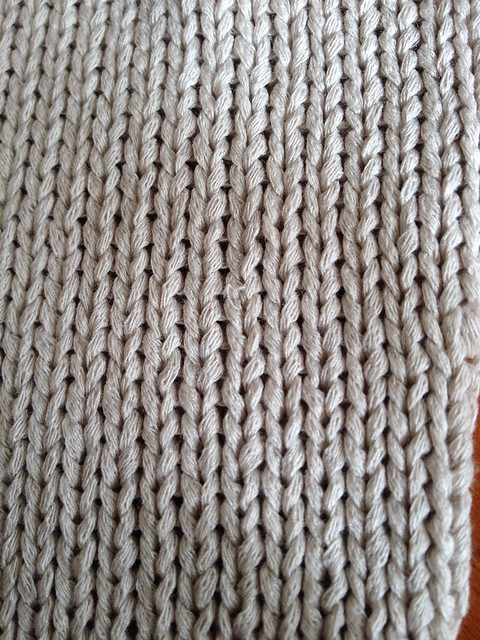
Let me digress for a minute here and talk about the yarn, which is probably significant enough to be designated Clue number four...and a very mystifying clue that is, too. A close look at the exposed end there in the underarm confirms that it has a chainette construction, not plied (although looking at the knitted fabric, I initially though that it was a plied yarn with a very low twist). It has a dry, crepe-like hand, and is knit at a pretty open gauge that gives it a nice fluid drape. I noticed in closeups that it has just the slightest tendency to pill in the way characteristic of cotton; however, it also has a little bit of sheen, which suggests either a synthetic or maybe a touch of silk. The dry hand certainly calls to mind that of a raw silk, but it doesn't have the squeak of a pure or high-silk-content blend. My best guess so far, without the aid of microscopy, is that it's a DK or light worsted-weight cotton-linen-viscose blend.

There are quite a few such blended-fiber chainette yarns on the market for handknitters--although the vast majority are sold in 50g put-ups, which would have required joins somewhere in the body for sure! Chainettes can't readily be spliced invisibly like plied yarns can, and neither can cellulosic fibers like cotton and linen, which don't felt. This garment was almost certainly made with three long strands (two for the sleeves, one jumbo-length one for the body), not of seven or eight 50g balls of something (I haven't yet weighed it, but I will--I'm guessing it's close to 400g). But then again, you can see in the fabric here and there an occasional little loop from a split strand--less likely in machine-knit fabric, but a regular occurrence for even the most meticulous handknitter. Hmmm again!
image

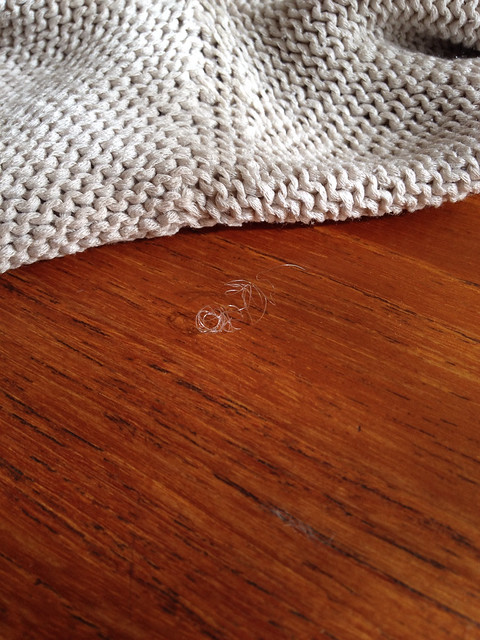
Back to the finishing question, though. Looking at the back neck edge to see what kind of bind-off and finishing technique was used there, I happened to see a wee filament sticking out around the yarn end. It was partly unravelled, so I carefully trimmed the loose portion (no, reader, I did NOT pull it! Tempting, but NO). It turned out to be some kind of transparent monofilament, which, upon close inspection, was wound around the ends at the cast-ons and underarms, too. (Look closely at the underarm seam image above, and you might be able to just make it out there.) Curiouser and curiouser!
image

I have searched the Ravelry forums at some length, and the only people who are talking about monofilament seem to be weavers and spinners, not knitters. I don't personally know anyone who's using this as a finishing technique for ends, although it's certainly an effective one (those ends ARE nice and tidy!). It is an unusually soft and fine variety of monofilament--not stiff or scratchy like fishing line. It may be a specialty product, but it's not one I'm familiar with. This one little piece of the puzzle is the bit that makes me most perplexed about whether this is, in fact, an entirely handmade, one-of-a-kind garment, or a high-quality piece of manufactured goods, perhaps with a handknit component.

As with some of the cases I observed while doing fieldwork with CSIs for my dissertation, the forensic evidence is compelling, but not 100% conclusive. Some elements of mystery remain here; perhaps someone out there has answers. Knitters, do you know anyone who uses monofilament to finish ends in their handknits? Do you recognize this yarn? Did you (or some knitter you know) make this garment and then donate it to a thrift shop in southern California...or give it to someone who would have? Have you perhaps seen an identical garment on the rack in some high-end boutique somewhere? Write and let me know!

If this WAS something you (or a knitter you know) made, you might be happy to hear that it is now T.'s favorite sweater--she said she's been wearing it pretty much nonstop since finding it in that thrift shop. So, I'll be working on a reverse-engineered copy of this simple but beautiful garment for when she wears the original out. Stay tuned for a post on that project in 2015, and in the meantime, have a great holiday season!

Monday, June 30, 2014

Four-letter word, starts with Y

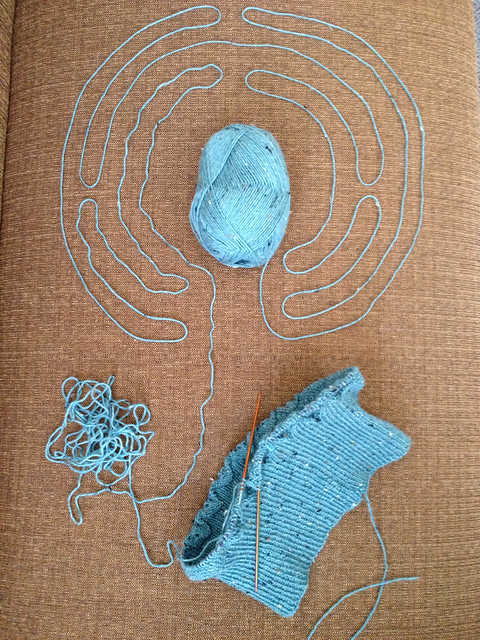
Yarn labyrinth

The summer solstice was last Saturday, June 21, and with it came the start of the summer challenge at my LYS...Local Yoga Studio, that is. The studio I go to does these challenges twice a year; whether or not I make the goal, I always learn something from them.

In that way, and many others, a yoga practice has so much in common with knitting. It can be loose or structured, fancy or simple, but however lengthy or involved the finished project, when you pull it all apart you can see that it's got just a single thread running through it. Breath is the yarn of yoga--there is no in without an out, no knit without a purl, and the little spaces between them are as important as the stitches and breaths themselves. They can be smooth and even, or loose and raggedy, but each stitch builds from and connects to the other as one breath follows another. The most intricate-looking contortions turn out to come easily when you perform them one step at a time--and this sometimes happens on the very same day that just lying flat and still poses the hugest challenge. In some yoga poses, or asanas, we are encouraged to look at an imaginary point somewhere far beyond our fingertips; likewise, when we cast on, we're gazing a thousand yards away to the finished project that the stitches we're creating will become. Take a look at pictures of FOs from a knitalong, and it's like seeing students in a yoga class--everyone makes their own unique expression of the pose or the pattern, with color, proportion and modifications in infinite combinations. I love the people I do these things with, too; they understand me in a way that other people never will, because we speak a common language, use the same special tools, and encourage one another to create things of beauty.

As with any practice that has a meditative element, I find the time I spend knitting or doing yoga on a daily basis actually creates space and freedom in my life. On Monday, one of my teachers shared a version of a passage from the Tao Te Ching that echoed this: "Water nourishes everything, and competes with nothing." Getting up a little early (OK, sometimes it feels VERY early) to attend a 7:00 AM community flow class means I get to work earlier than usual, and in a better mood, because I've already accomplished something by 8:00 besides rolling over and kicking the cat off the bed. Knitting lets me feel like my quiet time is productive, but it's also a way I can challenge myself mentally and take real joy in the process. It's a space where I can fail and still love myself; where I can try and try until I get it right; where I've acquired tremendous skill and fearlessness bit by bit. These minutes aren't spent, they're invested.

The goal of this summer's challenge is to attend no less than 25 yoga classes in the next 30 days...a pretty tall order, especially since I'm going to be out of town for several days during that time frame. So far so good, though: I've logged eight classes in the first five days, so I can even be lazy and skip a day. Like I said before, though, even if I don't make the goal, I know I'll get something out of this; I always have. Summer 2011, when I moved back to LA and started attending classes at this studio, was my first challenge; that was also my first year of being able to touch my toes, after 30 years of tight hamstrings. I was so excited about it, I would bend down and touch my toes for no reason--just because I finally could! Summer 2012, I added headstands in the middle of the room to my practice. That winter, though, I really struggled to make it in to the studio at all. I had a new job, and couldn't seem to get myself to classes on time, even though I WANTED to be there and make room in my life for a consistent practice. I realized I had to just do something differently, and that's when I first tried getting up early for that 7:00 AM class. This week, I've gotten up early three days in a row, and I'm going for five. Maybe even six...

But now that I'm near the end of this post, I realize I may already have gotten my Big Lesson from the challenge this time around. The last time I did a big clean-up in my office at home, the part that really stressed me out and pushed me over the edge into tears was sorting through the many half-finished and sketched-and-swatched-and-started-then-frogged projects that had accumulated here and there over the months. At the time, I could only see them as failures. I thought I should have been clever or disciplined or committed enough to realize my visions, and was disappointed at this evidence that, most of the time, I hadn't. All those false starts got jumbled together in my mind with my unfinished dissertation and all the other overdue-for-no-good-reason projects that tortured and shamed me. I went looking for that box of swatches this weekend, though, just after the start of the challenge. Now, I find I can see them as worthy efforts; variously, they were experiments, riffs, ends in themselves, twists in the labyrinth. They're where I've fallen seven times, and stood up eight. I could probably do 25 of them in 30 days, too.

Thursday, June 26, 2014

Summer here

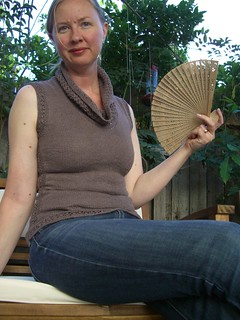
Last week was a busy one. On the 18th, Knit Picks launched a new yarn line called Lindy Chain, and along with it, a new design of mine that's just the thing for summer knitting: the Beryl sleeveless top!
CIMG3299
Click on the image for pattern and yarn purchase info!


Lindy Chain is a fingering-weight linen and pima cotton blend, which made it a new fiber experience for me--I've never worked with linen or linen-blend yarns before, although I've had a big hank of laceweight linen in a very exciting grassy-lime green shade in my stash since a yarn swap a few years back. I've always been a little hesitant to use that hank, honestly, since I've heard linen can be really hard on your hands and wrists, and stiff and scratchy and prone to tangling and generally unpleasant to be around until after it's blocked. I have friends who swear by linen-cotton blends for things like washcloths and dishcloths, since it responds really well to hard use, getting softer and softer, but I've never actually made a dishcloth, so...me and linen have so far failed to mix.

The thing that made me eager to try Lindy Chain, though, was that it's a chainette construction; that is, instead of having two or more finer strands twisted together (or plied, to use the technical term), the yarn consists of thread-fine strands that are knitted together, like a very, very fine i-cord. You can actually see the little V's of the chain in this close-up image of the rich golden Honey colorway:

http://www.knitpicks.com/yarns/Lindy_Chain___D5420254.html
 
Nifty, huh? There aren't a lot of chainette yarns out there, and most of the ones that you can get are novelty yarns (another category I've used very seldom so far in my knitting life). However, one of my all-time favorite yarns, Rowan Calmer, is a chainette, and I've always loved its special qualities--stretchy but not droopy, with great stitch definition, and really forgiving on the needles. It also made perfect sense to me that if anything could tame the linen beast, it would be a chain.

So now I've tried Lindy, and I definitely see why people LOVE linen. The finished fabric was a little rough before washing and blocking (my contact at Knit Picks used the word "rustic," which I think is perfect), but I noticed it softening even as I worked with it--the bottom of the garment already had a more hospitable hand than the top by the time I had about 7 or 8 inches worked, so just the action of moving the fabric around as I knitted was clearly limbering it up. The next time I work with it, I'll probably try bamboo needles or something with a blunter tip. Usually I'm all about laser-sharp needle points when I knit; like many knitters, though, I found the linen fibers to be a bit splitty, which a rounder needle tip will mitigate. But man, talk about cool and drapey! The finished fabric was soft enough to wear next to the skin, and I've NEVER been so comfy wearing a handknit garment in the summertime. I can easily see remaking a lot of my sock-yarn designs in Lindy Chain for spring/summer/early fall wear here in California. The Cecily Twinset, for instance, would look great in any of the 20 nature-inspired colors this yarn comes in. I'm partial to Bluebell, but Conch and Celery and Linen are all pretty, too...

Thursday, June 5, 2014

Did I mention I went to Amsterdam?

Because I totally did! It was great, not least because of the fiber-craft scene there, which is small but vibrant. The impetus for this trip was the Orphan Film Symposium, which was being held overseas for the first time, at the EYE Film Institute, housed in a spectacular new building overlooking the Amsterdam waterfront. But I found plenty of ways to intertwine this trip with yarns, fabric, buttons, and knitting, of course!

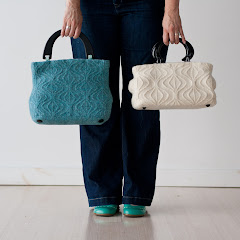
More treasures from the Katten KabinetAs some of you may know, when I'm not knitting, I'm an audiovisual archivist. My specialty is the preservation of home movies and amateur film, and researching how those media have been integrated into our larger cultural heritage over the decades since their introduction. I'm a co-founder of the international Home Movie Day event and the nonprofit Center for Home Movies; my Billington Bag pattern is named for the current Librarian of Congress, and proceeds from sales benefit CHM and their efforts to preserve and provide access to amateur films from all over the world.

While these two sides of my identity may seem distinct, they're quite closely related. Home movies and handknits have lots in common: First off, there's the fact that they are both made of yards and yards of long skinny stuff, and they both have lots and lots of little tiny holes in them. They are also deeply personal, and highly reflective of the time and place they were made, not to mention the people who made them. They're often far more colorful than their mass-produced counterparts, and of course they're totally unique. With careful preservation, they can last for many years in pristine condition, but even when they're worn almost to tatters, they're still special.

It shouldn't come as a surprise, therefore, to hear that I wasn't the only person in the audience knitting my way through this symposium! One of my cherished colleagues, Catherine, had a lovely beaded shawl project going, and she was clicking away softly in the dark next to me while I worked on a baby blanket for my friends' son-in-progress. There was definitely at least one sock project in the works in that auditorium, too, but I didn't get a chance to ask the knitter about it--the program was jam-packed, as always, with amazing new discoveries, preservation premieres, rarities and one-of-a-kind productions, and there was hardly time to breathe during the meal breaks, let alone wolf down a delicious plateful of Indonesian food, before heading back into the theater for more screenings and talks.

Under the circumstances, I was truly glad that I'd built a couple of extra days into the trip earlier in the week--mostly to stave off jetlag, but also to ensure that I  had time to meet with my counterparts in the Presentation and Preservation of the Moving Image master's program at the University of Amsterdam...and to go yarn shopping, of course! Catherine was kind enough to show me the highlights of her city, and through her I met some truly lovely fellow-knitters. The night I arrived, I joined her at the Thursday-evening knit night hosted by charming LYS Penelope. Everyone there was lovely, wearing lovely things they'd knitted themselves, and they were all very much knitters after my own heart. Someone even baked a rhubarb cake to share with us, which was divine. (Since coming back, I've made that recipe twice...yum!)

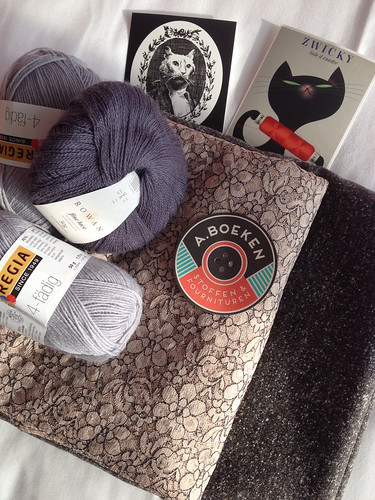
On the weekend, Catherine and I met up again to make the rounds of fabric, yarn, and button shops all over town via bike. The bicycle is the dominant form of life in Amsterdam, and the whole city is way more navigable on two wheels than four--a major, albeit very pleasant, change from auto-centric Los Angeles. I swear, I haven't ridden bikes with friends this much since I was ten years old! Although the cargo capacity of a rented three-speed cruiser (not to mention the ever-tighter restrictions on free checked baggage for international flights) puts a natural cap on shopping, and on the whole I was pretty restrained, I did manage to bring home a lovely haul. Behold!

image

One of our first stops was at A. Boeken, a stoffen and fournituren (fabric and notions) shop on Nieuwe Hoogstraat recommended by a lovely Raveler  in the Stitch 'n Bitch Amsterdam group (thanks for the tip, briocher!). Like many places in ancient, canal-crossed Amsterdam, this shop is taller than it is wide, but packed to the rafters with lovely things. I got several yards of re-embroidered lace and a dead classy three-season tweed in a color blend that's part charcoal, part coffee. Then we hit De Afstap on Oude Leliestraat, which has one of the best selections of Rowan yarns I've seen in a long time. Their prices were either really reasonable, or else I was doing the Euros-to-dollars math wrong; regardless, I scored some Rowan Fine Lace in a dusky violet and their last four balls of Regia 4-fadig in a pale silvery lavender color (which will go great with the browny tweed, whatever that becomes). We rounded out the expedition with a wander through the Albert Cuyp market, which has a handful of fabric shops, each with its own specialty: quilting cottons, decor, fashion fabrics, couture textiles, imported batiks. Finally, we browsed respectfully through the collection at the Knopenwinkel button shop, got some chocolate, and called it a day.

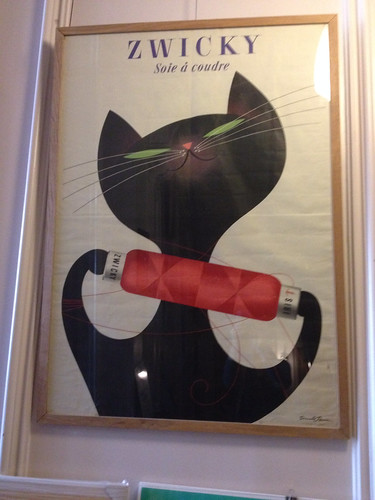
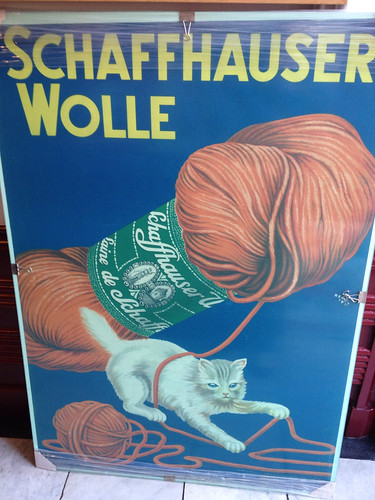
While I chose to leave the Anne Frank House for my next visit, I didn't neglect the great cultural treasures of the city. I made a dutiful pilgrimage to the Rijksmuseum and joined the massive crowds contemplating the equally-massive Rembrandt group portraits (but really preferred their decorative arts collection, which had some amazeballs cabinets inlaid with ivory and mother-of-pearl, and a surprisingly touching display of woolen hats found in the graves of ancient whalers).  Thanks to my Lonely Planet pocket guide, I also found my way to the Katten Kabinet, or Cat Museum! This is a private collection housed in one of the lavish homes on the Golden Bend. It's quirky, to say the least, and as you might imagine, yarn and cats playing with yarn are frequent motifs in the works on display here!

More treasures from the Katten Kabinet

There was one 17th-century genre painting of a cat with its paw caught in a steel trap, which was awfully disturbing, but the little bronze statuette of a cat pooping ("Poepende Kat" (1989) by Monica Rotgans) may well be my favorite piece of art ever.

Every Dutch native I talked to there said the weather was unseasonably fine that week; I have no basis for comparison, this being my first trip to the country, let alone the city, but the sunshine and budding trees were indisputably pretty.

image

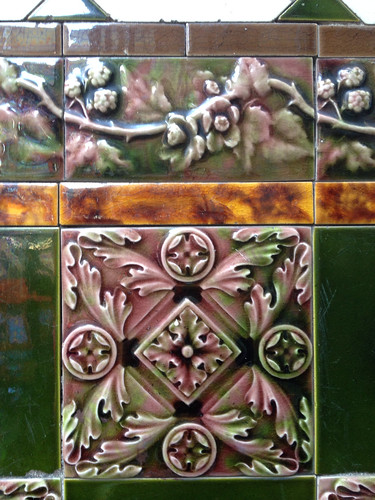
So, too, were the myriad architectural details of this old-world city: Antique tiles and delicate stonework abound there. You will miss a lot if you have to spend all your time there looking out for speeding bicycles, so be sure to take plenty of breaks for beers by the canal and people-watching if you go there yourself. And keep an eye out for me, too; I'm definitely going back at my earliest opportunity!

image


Thursday, May 29, 2014

Just released (finally!): Irma!

This is one of those designs that's been ALMOST ready to go for longer than I care to even think about. It's been waiting for those last few tweaks (pesky things like double-checking measurements and making schematics, which are my two least favorite parts of the technical editing process) for months and months and months on end. It's not all wasted time; in those same months, I've been field-testing (a.k.a. wearing all the time) the original prototypes, and have had a couple of friends test-knitting the original, non-schematic-ed, non-double-checked drafts and alerting me to minor errors and typos. And fortunately, the original photo shoot was done right around the same time of year as this, so maybe no one will look closely and see how many more crow's feet I have now. Without further ado, I give you... Irma!

CIMG2877


I attended a workshop with Deborah Newton at Vogue Knitting Live in LA a few years ago, which was well worth the price of admission. The fee included a copy of her then-new book Finishing School: A Master Class for Knitters, a welcome addition to my reference shelf, and Newton's own expertise and advice were invaluable! One of the many things I learned that week was that every knitter--young and old, experienced and novice--has their very own set of strongly held opinions about knitting, yarn, and everything associated with them. Deborah Newton, for instance, has near-religious convictions regarding seams in knitted garments--she's a big, big, big fan of 'em. In fact, she was so compelling on the subject of seams that I thought I'd go ahead and try designing a pieced-and-seamed cardigan myself, and Irma is it!

The Irma cardigan is a slightly airier, more feminine (if I can be gender-normative for a minute here) take on the shawl-collar sweaters all the hipster boys have traded their hoodies for as they've hit their mature (ha ha) years. It's worked in an allover columnar lace motif with deep ribbing at the cuffs and hem. And pockets, of course! I worked the original prototype, which is the jade green one shown above, in Simply Socks Yarn Company's solid wool/nylon "house blend." SSYC Solid is a yarn I really adore, not least for its springy plied texture, but also because it comes in, like, EVERY COLOR EVER. I also reknit the pattern, once it was (mostly) written, in Knit Picks Gloss Fingering in a dark gray color called Hawk. That yarn has a hint more luster and slightly crisper stitch definition, and makes the lace motif really pop. It also has an elegant drape in stockinette, thanks to its 30% silk blend, which helps the shawl collar roll while the button band lies splendidly flat, and that's why this yarn is another favorite of mine. (Yes, I have about forty-eleven different "favorite" yarns. Who doesn't?) Were I to make yet another one of these for myself--and I'm not ruling that out--I'd probably try a super-cozy and decadent winter version in Knit Picks Capretta, maybe in the Pesto colorway. But then, I'm a sucker for cashmere.

On the whole, I liked the seamed-garment experience. I learned to sew before I learned to knit, so on a fundamental level, the concept of taking flat pieces and building a garment out of them makes every bit as much sense to me as taking a strand of fiber and building it, stitch by stitch, row by row, into a shape that fits a body (or a hand, or a foot,  or what have you). For Irma, I used the crocheted-seam technique Newton demonstrated at the workshop and describes in her book; it was really fun to work, and I think I'll probably continue to use it for shoulder seams in preference to a three-needle bind-off. For one thing, it's easier to unwork and rework if you need to (if you've ever dismantled a thrift-shop sweater to recycle the yarn, you've probably already unworked a crocheted seam!). It also adds a skosh more structure to one part of a garment that really needs reinforcing, while still being flexible and elastic. And because it does use rather more yarn than a mattress-stitch seam or three-needle bind-off, you can even cannibalize it in a pinch if you need a foot or two of yarn to darn or patch a very well-worn garment. Unlike reserved leftover yarn, yarn transplanted from a seam will match the repaired area perfectly, since it's been laundered the same amount as the rest of the garment--so it's kind of a rainy-day account for your sweater! Which is good, because now that other people can actually knit this design for themselves, I'm halfway to wearing the prototpyes out.

Friday, May 2, 2014

Taking it down a notch

Sometimes you want a challenge; other times you just want things to be easy, and successful, and foolproof, and DONE. A Raveler posted a really good question recently on the pattern page for the Billington Bag:

Am I really the only one struggling to sew the darn lining? Maybe my interfacing is too stiff, but trying to fit the sides together is a nightmare. Rethinking the pattern to see if I can find a way to make the lining easier to sew.

You know what? I totally get it. The instructions for this design call for a pieced lining, where each of the four vertical sides is measured, shaped, and cut to conform really closely to the shape of the finished, felted bag.


Along with a good stiff interfacing, this pieced lining helps give the bag enough structure to stand open on its own, and prevents things like your car keys and cell phone from getting lost in folds of loose fabric. But it's a fussy process to sew corners and angles and seams on both sides of narrow strips of interfaced fabric, and dagnabit, there's just gotta be an easier way that gives ALMOST the same results, right? I think so--and here it is.

Instead of doing a pieced lining for the Billington Bag, knitters who want a shortcut to the finish line can try a modified sack lining. Three measurements, two pieces of fabric and matching interfacing, five seams (three of which are completely straight!), and you'll be ready to insert it.

Step 1: Measure.

Take your felted bag and flatten it out as shown below--so the top edges are even and the bottom of the bag is folded more or less in half along its long axis. Measure the width at the top of the bag (A), the width at the bottom of the bag (B), and the height from the top opening edge to the folded bottom edge (C).


Step 2: Cut.

Cut two rectangles of interfacing that measure B x C. Cut two rectangles of lining fabric that measure (B + 1") x (C + 1"). Center the interfacing on the lining fabric; you'll have 1/2" margins all the way around. Baste or tack interfacing in place on the wrong side of the fabric.

Step 3: Sew.

With right sides of fabric together, seam the two sides and the bottom closed, leaving the top open, like a pillowcase.

Subtract A from B; divide the remainder by 2, and mark a point that far in from the side of the interfacing on the top edge. (For instance, if your bottom width (B) is 14" and  top width (A) is 11", 14 - 11 = 3.  3 divided by 2 = 1.5, so you'll mark 1.5" in from the upper edge on both sides of the top.

If you're making the short version of the bag, fold it horizontally in thirds, and mark 1/3 of the way down on each side. Stitch a diagonal line from 1/3 down the side to the marked point on the upper edge, and trim away the excess, leaving 1/2" of lining fabric and trimming the interfacing very close to the stitching (1/8" or so). If you're making the tall version, do the same thing, but mark and stitch 1/4 of the way down the sides, instead of 1/3.

Now comes the tricky part (don't worry, it's not that tricky): Making the bottom of the lining flat! To do this, just put your hand inside the sack, down into one of the corners. Bring the side seam and the bottom seam together, pinching the corner flat. Sew straight across the flattened corner at the point where it's as wide as the inside bottom of your bag; repeat on the second side. (This is the same principle at work in paper grocery bags, so if you get lost and these caveman-level illustrations of mine are no help, take a look at the bottom of one of those!)
Step 4: Finish.

Tuck the triangular points under the bottom and tack in place, if you like (or just press them with under gently with an iron). Turn the upper edge of the lining fabric over the interfacing, insert the lining, and stitch to the upper edge of the bag. Done!

Monday, December 30, 2013

Tillie baby blanket

What do you know? It's baby season again. A colleague just announced her pregnancy, and I have two other friends with a bun in the proverbial oven now. Time to fire up the ol' baby-knitting engine and get some gifts in the works before the showers hit!

Luckily, I just finished writing up a pattern from the LAST baby avalanche I went through, in which a bunch of the expectant parents opted to find out the baby's gender on the day of delivery. While I totally respect the decision--and even admire it, as I wouldn't have the willpower to resist finding out--it does throw a bit of a wrench in the works when it comes to almost any kind of baby gift. I am seeing that there is NOT a lot of gender-neutral stuff out there past the plain white onesie. Even the items that come in yellow or pale green (which are apparently, and respectively, the classic and contemporary code colors for gender-nonspecific baby gear) tend to have some coded gender references. You know, ladybugs or lizards, that kind of shit.

Knitting patterns aren't much better, although the silhouettes are at least more non-aligned. Where you hit the wall with those is in the baby-yarns section of the LYS, which just looks like Tinkerbell's toilet to me. LOTTA pastels on that wall, folks. Don't babies need basic black and classic navy too? Or, you know, teal and tangerine and deep, rich earth tones?

If anyone knows a better way to style a baby blanket than draping it on a chair, please tell me.

I'm not saying I've totally solved these problems, but along with the Peabey Bear stuffed animal (which is nice because it's soft and baby-safe, especially if you knit it up in and stuff it with organic cotton) the Tillie Blanket pattern is my stab at it. It's got a bit of eyelet texture, so it's not so boring to knit, and there's a subtle flounce at the edge, yet the overall effect is not so lacy and ruffly as to be categorically girly-girly. It works just as well in blue or pink as it would in yellow or soft green; I opted for a nice sandy neutral, which should go with pretty much anything (but coordinates especially well with burp stains). It's worked up in an easy-care sport-weight yarn that comes in a wide range of colors--including a fabulous tangerine orange, rich red, chocolate-y brown, and yes, basic black, if the baby in question has a daring fashion sense or artsy parents who would go for that. No more waiting 'till the baby comes out to cast on and start knitting!


Monday, December 23, 2013

Christmas blues!

Dear Santa,

It's great that you came early this year with a set of those new Caspian interchangeable needle tips from Knit Picks, because I'm still clinging to the idea that I might fulfill my New Year's resolution to seriously bust some stash in 2013. New needles are going to be just the thing to help me settle in with a few pounds of wool and all ninety-one hours of the Lord of the Rings trilogy and crank out stuff for everyone's stockings before the clock runs out on my promise to myself!

I really am absurdly pleased by these babies. Something non-knitters, or new knitters, often find surprising is the intensely personal--and contingent--nature of one's choice of needles. (Actually, what non-knitters seem to find most surprising that there is more than one kind, since point sticks are pointy sticks, right? I can't tell you the number of times I've been knitting in public on circulars and seen that puzzled look on someone's face that comes immediately before they ask, "What does that string in between the sticks do?")

(Image from WoolFreeandLovinKnit--thx!)

Me, I've been through 'em all, practically. As a kid, I first learned on the kind of metal-capped, size 8, pastel-coral-colored plastic straights that look so nice arranged in an antique jug in your sun-drenched craft studio. I knitted on and off throughout my teens and twenties, mostly with a few pairs of hand-me-down plastic circulars from my mom's 70's-era collection (possibly Bryspun, but I've never been able to verify that conclusively). I didn't know anything about gauge and was pretty cavalier about things like fit and finish, so the results weren't always great, but at the time I did like the way they felt in my hands--springy, with nice sharp tips that slid neatly in and out of the stitches. The plastic finish was smooth, but not so much so that the needles were always slipping out of the live stitches at inopportune moments or during transit.

When I got more serious about knitting in my late twenties and early thirties, I discovered that gauge was a thing, and that you actually get better results when you use the right size needles (see, kids? College, graduate school, and then more graduate school really do make you smarter!). So I started buying needles as needed for various projects: Lantern Moon ebony circulars, Chiao Goo bamboo dpns, the odd pair of Addi Turbos. I developed a wee obsession with Brittany birch dpns for a while there--I liked that there were five in each set, instead of four (having lost a couple of those extra needles to cat-chewing incidents over the years) and the smooth blond wood spoke to me, especially in the shorter lengths they offered. But I will freely admit that for a long time I was a promiscuous knitter--I'd still go with just about anything that came to hand, and my needle library was a real hodgepodge of different brands, styles, and sizes. Given the only common feature, which was that they were mostly sizes 4-6 (with just the occasional 8 or 9), you really could say I knitted like I dated...

So perhaps it's no coincidence that when I moved to Texas in 2006 with my new husband, I was finally ready to settle down with one kind of needle, the one that was just right for this here Goldilocks. Turns out the Knit Picks Options interchangeable tips in the Harmony wood finish was THE NEEDLE FOR ME. Other Harmony knitters will know exactly why: Super-pointy tips; smooth but still toothy finish on the wood; fine, flexible cables with unobtrusive joins; very reasonable price point. The only thing I didn't love about these needles was that they were...purple.  I don't hate the color; obviously, it's not a dealbreaker, since I've been knitting happily on these needles for years now. I have a plum-colored dress I quite like, and a dusty lilac one, too. But I'm not really a purple person, and deep down in my heart, I confess, I have wished for these needles to be a different color. (Different, that is, from any of the OTHER three finish options these needles come in, which include a nickel-finish metal, Zephyr clear acrylic, and Sunstruck blond-wood laminate, none of which are so much better than the original purple for my purposes that I've felt it worth switching...perhaps since they all come with the signature purple cable.)

Lo and behold, they come out with these Caspian needles! They're a beautiful peacock-tail blend of blues and greens, with lovely deep-teal cables. I heart them so much; they're just what I've been wishing for all these years. To paraphrase Dean Martin: Santa may have brought you some stars for your shoes, but Knit Picks kindly gave me the blues...the ocean-colored, emerald-cabled Caspian blues.

I'll be wishing all of you the best for a warm and joyous holiday season, and for a bright and bountiful year to come!

Wednesday, December 4, 2013

Winter Bride

Thanks for checking in--I'm back, and with a new pattern, too! Winter Bride Gloves just went up on Ravelry, and is perfect for your holiday giving projects (fancy! but easier than they look) as well as any New Year's nuptials to which you might be invited (buttercream frosting will blend right in on these babies).

I've missed knitting, but putting together a new pattern was fun, and I'm really pleased with how these turned out. It's almost enough to make all those false starts from the last year feel more like sketches than failures. (A recent home-office clean-up effort ended with me surrounded by a pile of half-finished and aborted and unraveling attempts at all kinds of things, in tears and feeling like they were a self-portrait of the artist as a young fuck-up...and honestly, I'm not even that young!) With luck, these will be the first little flurries that turn into a proper snowstorm of creativity. Watch this space!

Wednesday, May 15, 2013

Players gonna play, ballers gonna ball.

You know what? It's been a tough couple of months. We finally said goodbye to our sick kitty at the end of April (see previous post), I've been making little headway on my dissertation, my Myrtle cardigan went through the wash and came out with a gaping hole that seems to have unraveled from a dropped stitch...

Ruh-roh!

And the cherry on top of the dog-poop sundae? This weekend saw the return, once again, of some dissatisfied customers who periodically post nasty comments about one of my patterns on Ravelry. Now, I know I'm not perfect, and neither are my patterns--errors, omissions, and just plain bad writing can and will make it through even the most rigorous tech-editing and test-knitting protocols, and this was an early release for me, so my protocols weren't the best then--but I make an effort. And these are people A) whom I did make an honest and strenuous effort to assist, B) most of whose problems I was unable to replicate myself, and C) to whom I not only apologized, repeatedly and sincerely, and gave a full refund of their purchase price, but ALSO offered their choice of a different pattern from my own store, or any pattern from their own Ravelry queue, as a gift, by way of apology for the inconvenience.

A reasonable person might consider our business concluded with that refund. But still, going on two years after their initial complaint to me, a couple of them will periodically log on to Ravelry and post afresh on the pattern page, calling the pattern unworkable and me unethical, a fraud, an unhelpful person, etc. I delete these comments as soon as I'm notified about them, which only seems to make them angrier. The content of the comments now has as much to do with the fact that I deleted their previous comments (and am therefore unscrupulous, amoral, and foolishly loath to peacefully accept their well-intended defamation) as it does with the fact that they had trouble knitting the pattern. (I should note, and you'll have to take my word for it, that these are the only comments I've ever deleted from a pattern page.) For what it's worth, I'll respond personally or publicly (depending on the situation) to Ravelry forum posts that are critical in nature. I'll even reach out to someone personally if their project notes indicate that they encountered a problem or error that they didn't convey to me directly, thanking them for the heads-up and letting them know if, for instance, a new version has been released with a corresponding correction. But my very strong feeling is that I'm not morally obliged to allow anyone to defame me in my own (virtual) store, and no unhappy customer is morally obliged to tell all potential purchasers of the pattern know they had issues with it and/or me. Especially after they've gotten their money back! Or, to put it most succinctly:

Embroidery project
One reason this phrase has such power is that it speaks to the fundamental vulnerability required of everyone who does something creative. If you publish, perform, work collaboratively or in teams, or otherwise live out loud, you're inevitably going to hear from some haters. Much as I'd like to say I've learned to rise above it like Princess Pony galloping across the rainbow to Glittertown, that vulnerability can be really crippling. The haters speak much louder than the lovers in the ol' interior monologue, even though the lovers almost always outnumber the haters.

Worse yet, the hate of the haters is infectious. A very talented friend recently asked me about starting to publish her own designs, and the first draft of my response to her was a real shit sandwich: Your ideas are great! You should definitely give publishing them a try! People are going to be totally crappy to you, of course, and you'll spend most of your time dealing with inane tech-support questions, especially for the patterns you give away for free, and still other people will pretend the Internet exists solely so they can revive the petty tyrannies of middle school and make fun of you for making your own clothes. But totally, you should put your beautiful and inspired work out there!' It'll be super-fulfilling, except for when it makes you want to die inside! Although I think I managed to make it somewhat more encouraging of her wonderful talent and potential, and much less about my personal experiences and insecurities, I'm ashamed of how much of the latter made it into the final response that I eventually did send her.

So do me a favor, everyone out there: While I take crochet hook in hand and set to mending my messed-up Myrtle, take a minute today to send someone--whether you know them or not--a wholly positive, wholly unsolicited compliment on their creative work. Or write a nice thank-you note to someone. Give a penny instead of taking one (or instead of putting your two cents in, if they're two picky cents). Above all, don't hate! There's already plenty of that going around.

Sunday, January 13, 2013

The life cycle of warm, fuzzy things

Back in June of 2009, I bought some yarn. My friend Stephi custom-dyed it for me in my favorite shade of gray. It was a super-soft laceweight singles merino--a lot like Malabrigo lace, but obviously better because it was made just for me!

Graphite merino lace singles

In July, I started a new sweater project to keep my hands busy during a fascinating symposium on noncommercial film in a small town in Maine. I was experimenting with new construction methods, and particularly fascinated with seamless, top-down, and reversible garments, and with a little bit of tinkering and tinking I came up with something I really liked.

Agatha - FO

Soon thereafter, Knit Picks launched their Independent Designer Program, and asked me to join their initial roster of collaborators. Although first executed in a laceweight yarn, Agatha was a great candidate for adaptation to heavier gauges, and it became my first IDP submission.


 Just being invited to distribute my designs through Knit Picks was a huge deal for me, but seeing the Agatha pattern in the pages of the catalog was really a kick. It was the first time a real model had worn one of my sweaters, and also the first time I'd seen my work in print. Prior to that, I'd published a pattern in Knitty, which was an equally major accomplishment, but this was the first time I had something I could send to my mom for her to brag about to her friends. (She's got an iPad now, and is totes web-savvy, but back then she was all about the paper media.)


A few months later, when I was in Washington state to visit family, I took a day trip down to the Knit Picks offices and met the whole gang down there, including Stacey, the IDP coordinator. I wore the original Agatha to meet them, of course, knowing I'd get props from them as fellow knitters...

CIMG2189


That day was especially exciting because it just happened to be the day that Agatha became the first IDP pattern to pass the milestone of 1,000 copies sold! It's still one of their top sellers, I'm happy to say--and remains firmly in the top 3 for my patterns on Ravelry, both for copies sold and total number of projects from all users. Given that Knit Picks reaches a lot of non-Ravelers through their web site and mail-order business, I strongly suspect that more people have made Agatha than any of my other designs.

Over the years, that original Agatha was my go-to sweater on a daily basis. Being reversible was a major factor in that, I'm sure; I could strip it off one day and toss it on the next with a minimum of fuss and bother. Of course, that meant it also saw a LOT of wear...it was my favorite thing for pulling together an elegant outfit with a skirt and camisole, and also the perfect all-purpose extra layer on days that were a little too cool for a t-shirt but a little too warm for a fleece or a heavier pullover. This was how I eventually learned that singles yarn, while awfully soft, is also really pill-prone. My Agatha held up manfully, but it was inevitable that age and use would start to tell on the fine yarn I'd knit it with.  About a year and a half ago, Agatha made the transition to "evenings and weekends" status--OK for wearing to the Farmer's Market on a Sunday morning, or throwing on when I changed into jeans after work and before heading out to a casual dinner, but no longer something I'd want to wear to present a paper at a conference or teach a class. As the pills continued to multiply, and the elbows and underarms and center back got increasingly thin and felty, Agatha stayed soft and eminently wearable, so soon she was got further downgraded to my "geez it's chilly in this bedroom!" choice. She went great with my gray flannel pajama pants and my cat-hair-covered black fleece pants, or occasionally with my yoga pants when I biked to the studio on a breezy day for a Restorative class.

I should note that this transition has always been hard for me to make with favorite garments, and that it is an interative and gradual process, not an immediate one. I once had the following conversation with a coworker about my then-favorite black wool cardigan:

ME: Oh, crap, my button's coming off again.

Co-Worker: Yeah, it looks like you have a little hole there, too.

ME: I know. This sweater is totally my favorite, but I guess it's getting kind of ratty. I'm probably going to wear it until someone pulls me aside and tells me to stop.

Co-Worker: .....

ME: I should just stop wearing it now, huh?

Co-Worker: Yup.

So I will admit that I more than likely wore Agatha out in public for much longer than my normally acute shame-o-meter might have allowed. (I really gotta get that thing recalibrated...)

About nine months ago, after nearly three years of cat-hair accrual and continuous, year-round, and enthusiastic wear, after which it was often tossed on the foot of the bed, Agatha made a further step, this time to "cat nesting sweater." Our kitty Totoro has always been irresistibly drawn to anything sweaterlike left anywhere on the surface of the bed. In the time it takes to walk out of the room and come back in, he will be ON that sweater, feet firmly tucked under him in fresh-baked-loaf-of-cat position, showing no inclination to move. Who could fight something that cute? I'd just have to pull a different sweater from the pile on the shelf so he could stay put. And it made me feel better to not be giving Agatha UP for myself, but giving it TO my cats so that they could get the same enjoyment I had.

Last week, Totoro went to the vet for a check-up after having lost a noticeable amount of weight. His blood tests came back with wildly elevated creatinine levels, which along with some additional tests pointed to congenital (and incurable) kidney dysplasia. He spent the next several days in the hospital, getting his itty bitty kitty kidneys flushed with IV fluids and a course of antibiotics, while we waited to see if his numbers would respond to treatment and the crisis would pass. I brought Agatha with me to visiting hours so he'd have something that smelled and felt familiar in the midst of what was probably a very scary and stressful experience. You can just see the IV line leading off his leg at the bottom left of the picture below.


We brought him home again on Tuesday, and he's perking along, as my mom would say. We'll see how he does with periodic injections to keep him hydrated, continuing antibiotics, and some antacids to counteract the effects of his impaired kidney function. Our effort is to keep him relatively comfortable and interested in eating and living normally for as long as possible. Sadly, the damage that this renal crisis did (or just alerted us to) is progressive and irreversible. His kidneys are going to work harder and harder, with less and less effect; he'll get tired, drink and pee a lot, and lose whatever weight we do get back on him. Eventually--and who knows exactly when--we'll have to help Totoro have a peaceful and painless end.

Sweaters wear out, and so do living things. In the long run, it makes no difference how much we love them, nor whether we use them gently or harshly--there will come and end to it. Totoro's warmer and softer than any sweater I've ever knitted, obviously, so I'm expecting it to be much harder to say goodbye to him, and there won't be the same opportunity to move him progressively through everyday, "go-to" use to "evenings and weekends," either. I'm trying hard to accept the fact that he'll have to go straight to "cat nesting" status, and recognize that moment when it comes. After all, he's ALREADY covered in cat hair, which makes it a lot harder to tell...

Thursday, January 10, 2013

Happy New Year, and congrats, contest winners!

Welcome to 2013--and congrats to the winners of the end-of-year giveaway draw, MJ and Barb!

Interestingly, MJ and Barb both posted about giving of themselves in a very specific, physical way--through blood donation and signing up with the bone marrow and tissue registry. That's something I've been meaning to do myself since moving back to Los Angeles in 2011, so this was a great motivator for me to go and join the Be the Match registry online. Consider signing up yourselves--it only takes a few minutes, and if you're young and in good health, being a tissue donor is one of many ways you can share that gift with others.

Barb and MJ, please email me directly with your mailing info, so I can get your copies of the first Sock Report volume sent off to you right away. (I'm reachable at TT820.B43 at gmail dot com, or via Ravelry--I'm TT820, if we're not already on one another's friends lists!) Be sure to let me know your favorite color and/or type of yarn so I can personalize the parcel for each of you, too. :-)

Although I could only pick two for the giveaway, I want you to know that ALL of your comments were inspiring--so much so that I'd like to give something to all of you in return. For the next week, you can use the coupon code IMAGIVER to get one free pattern download** from my Ravelry store! Thanks for being such generous people, and making such a positive difference in the world around you. I'm glad to know ya.

In the month or two ahead, you can expect some exciting things from me, including several new patterns, and a series of posts focusing on some of the trickier technical aspects of my existing designs. In the meantime, here's another teaser pic for an upcoming pattern release--the Chickpea blanket, also shown in my last post. This was designed for my friends' new baby, and I think it's PRETTY clear that she likes it...also, that she could NOT be cuter. That little yellow onesie just kills me; I wish it came in adult sizes.

DSC00921

**The fine print: This promo expires at midnight, PST on January 12. Limit one free pattern per user; you need not be a Raverly user to download. In the interest of simplicity for me, it's on the honor system, but capped at 34, the total number of comments...so if you DIDN'T post a comment last week, please don't steal a download from someone who did! You'll have other chances to get freebies from me in 2013, I promise. :-)

Friday, December 21, 2012

Once (again) upon a time

Season's greetings, one and all.

Today's the winter solstice--tonight, the longest night of the year--and as I prepare to do the traditional naked solstice dance around the traditional tiny facsimile of Stonehenge (what, that isn't something every family does at the holidays?) my thoughts go back to all the wonderful things I experienced during the lengthening days of springtime and summer, as well as forward to the year ahead.

Springtime saw the publication of the first issue of The Sock Report, of which I was so proud to be a founding contributor. I taught a terrific class in the spring quarter, during which I got to explore with my students a lot of natural processes, including photoreactivity, oxidation, humidification, acidification, and decomposition, that have an impact on heritage preservation as well as on the fiber arts. (I'll discuss one of them at greater length in a future post, when I've had a chance to take the necessary photos.) I saw a solar eclipse and a hummingbird snuggled in its thimble-sized nest. I played a tiny part in a profound work of art. I gave my first keynote speech at a conference.  Lots of friends had babies, so I knitted lots of baby stuff. And I learned to fly (a little bit, and with a lot of help). It was a great year in so many ways.

Chickpea

As the days start to get longer once again and the year renews itself, I'm making a renewed commitment to all the things that restore and enrich me. One of those things is giving--whether that's in the form of gifts, money, or time, or teaching and writing, or cooking and feeding the people I love most. Hugs will also be involved; I see a lot of those ahead in 2013. (Cheesy. I know. Don't care.) Another is knitting. So what better way to mark the solstice, start bringing the light back, and celebrate the close of one year and the opening of another than by giving a gift of knitting to those who give me the kind gift of their interest and attention?

 Leave a comment on this post any time between now and January 1, letting me know what you gave in 2012 and why that felt good. You might have given up smoking, given a stranger a high five at a football game, given a crap about the election, given your relationship another go, given a child up for adoption or given a puppy a new home, given someone change for a dollar or the shirt off your back, given a party, given your word, given at the office, given offense or given comfort. But you all gave something, and here's your chance to give your version of that event! I'll select two of the comments at random and send each of you a copy of the bound edition of the first issue of The Sock Report to help you start the year off right and look forward to it being spring again...

Thursday, August 9, 2012

Look but don't touch? Forget that!

Cascade Kid Seta

Sites like Knitty and Ravelry have brought us within a mouse-click of millions of amazing patterns, and online merchants have similarly enabled our yarn-stashing habits. Occasionally, one even hears about knitting video games, although no knitter I know plays them (and as the first comment on this post from 2010 makes clear, gamers don't seem clued in enough to know the difference between knitting and crochet--if there's yarn, they'll call it knitting, like all the other morons nice friendly people I meet when I craft in public).

It's obvious why knitting video games haven't been really popular, of course. Cost of a Wii = $149.99. Cost of knitting needles and enough yarn for a scarf = $14.99, tops. At the end of the Wii game, you have...a Wii. On which you can play the knitting game again until you get bored with it. At the end of the knitting, you have...a scarf! And needles, on which you can knit another scarf, or anything else you like. Duh! Real knitting totally wins.

Cascade Kid Seta

Beyond that, though, there's the fact that knitting is not a look-but-don't-touch pursuit. Knitters are touchy people (yes, in every sense). In fact, our handiwork involves all kinds of sensory signals. I often smell a skein before I buy it. I refer to colors as "delicious" or "tasty," and talk about yarns as being "creamy" or "crunchy." Our needles click and whisper, our swifts creak and our ball winders whir. Even our jargon is onomatopoetic--as my friend Julia explained to me, it's called frogging because you "rip it, rip it, rip it."

That sensory involvement in one's work is a familiar thing to me in my other professional life, too. As a film archivist and someone who teaches others to work with film and other materials in need of preservation, I've been thinking a lot recently about how much touch and feel, direct personal experience, and embodied knowledge are essential to understanding. This is just one more way in which knitting is connecting to my academic and intellectual life, I've discovered, so I'm going to think out loud here about both of them...

Cascade Kid Seta

That Wii knitting game really does have some interesting aspects--for one thing, it looks to me like it'd be helpful as an introduction to charted patterns, becoming comfortable with patterned stitches, and learning to read your knitted work-in-progress--but it presents knitting as a largely theoretical exercise, and knitted fabric as a straightforward product of idealized, sequential motions. It doesn't even hint at the dozens of signals a skilled knitter receives simultaneously through their eyes, ears, and fingers as s/he works. Like the hard little bump a purl stitch makes tugged against the needle in your right hand when you forget to bring the yarn back before working a knit stitch after it. The annoyingly raggedy loop of a split strand sticking out in the row below, and the satisfaction of dropping that stitch back and reworking it with the full strand. The way the weight of your project gradually tips from the left hand to the right as you work across a row, or the bunching and stretching between the needle tips that subtly influences you to push out stitches to the right and gather them up to the left as you work, without ever really stopping to think about it.

Cascade Kid Seta

All these little things have some kind of analogue in film handling, I find, where we also have joins and twists, and colors and smells, and where the way a long strand of something is wound and manipulated can create wonderful effects or catastrophic tangles. And while you can read about film preservation techniques online, or watch all sorts of stuff on YouTube--including knitting demos, of course!--there's really nothing like the real thing, which is why I've been doing Home Movie Day for the past ten years.

20101016_hmd_jodiecam_002
Thanks to punkybuddha for this great pic from 2010's Upper Valley Home Movie Day event!

For me, it's all about getting your hands on the stuff--finding places and ways to do that will yield so much rich information, as well as more satisfying products, and deeper, more lasting knowledge. In my next post, I'll be having a contest in which you can win both digital prizes and ones you can touch with your own personal digits, and I'll ask for your own thoughts and stories on what you've learned by doing and feeling...so stay tuned!

Tuesday, July 31, 2012

Dear kitties...

We have hardwood floors throughout our house, with laminate in the kitchen and tile in the bathroom. The couch and two of the four armchairs in our living room, as well as three of the five chairs in the dining room, AND my desk chair, are all leatherette. I can tell you from klutzy experience that these surfaces are really easy to clean.

But it seems that when it's time for you to do your barfing, kitties, you really only feel at home on the bed, or on one of the upholstered chairs, or--and this is the one that really gets me--smack dab in the middle of the throw pillow with the incredibly involved intarsia-knit cover that I was so proud of. (WAS.) To add insult to injury, you did that thing where you try to bury your mess, and clawed the knitted fabric up pretty badly all around the barf spot afterward.

You're cute, and I really do love you, but sometimes that's not enough. It's going to be a while before I forgive you for this.

CIMG1522

(I was going to post a picture of the barf and barf-related damage, but thought better of it. Instead, here's a picture of you two. Now everyone Knows What You Did.)

Tuesday, July 24, 2012

Fiber people are fab-er people

Here's where I've been the last week and a half. Jealous much?

Hero shot for Irma

That's my mom's garden in the background (well, part of it, anyway--there's like another acre and a half of it to either side).  And that's me, wearing the prototype for my newest design, Irma, the pattern for which is in the works and almost ready for test-knitting.

I got to enjoy a full week of abundant solitude, peace and quiet at my parents' place up here in the mountains of the Olympic Peninsula. During that time, I decompressed from a really intense week-long conference at UCLA, and got more or less caught up on email and some shamefully overdue committee tasks. Yay, me. I also poked around in some of the local antique malls, where I picked up a frickin' sweet Pyrex dish (with matching lid--score!), some vintage hankies (I got run-down during that conference, which I think helped trigger an allergy attack, and you can never have too many clean hankies on hand when your nose is running on and off all day), and a terrifically classy knitting pattern booklet from Montgomery Ward, circa late 1940s? Early 1950s? I'm guesstimating based on hats and hemlines...

Nice haul from the antique mall

That pleasant afternoon of prowling through old stuff was capped off nicely when, on the way back to my car, I happened across the recently-opened LYS just around the corner. Cabled Fiber Studio had a sign out front reading "Yes, you DO need more yarn! (And rods and reels.)" Ah, I thought, I am once more at home among my people...knitters and enablers! (Dear Hubby: If you're reading this, don't sweat it that you don't fish. I also spotted a shop on the way home called The Dragon's Something-or-Other that sells Warhammer fantasy miniatures, so you're covered on the reciprocal-indulgence-of-hobbies front. Who loves ya, baby?) I was also pleased to see that they'd yarnbombed the public art on the sidewalk outside the shop, bringing a much-needed touch of color and pizzazz to the small-town street. Two of the proprietors, Mary Sue and Beth, were in the shop that afternoon, along with a couple of local knitters who were settling in for the weekly knit night, and they all made me feel very welcome indeed!

Cabled Fiber just opened a few months ago, and I'm rooting for them to make a real go of it. They've not only created a beautiful and inviting retail space, with a focus on locally-sourced and hand-dyed yarns, tools, and roving; they've also coordinated a great lineup of classes, and they've jumped right in as supporters of the local arts scene and community events, too. When I stopped by, they were working on assembling little mini-skeins of yarn for a hand-dyeing workshop at the upcoming arts weekend, and Beth was tinkering with an old knitting machine they had so she could experiment with a pattern she'd found for machine-knitted slippers. She and Mary Sue showed me around their shop, and we chatted about my visit to the Knit Picks headquarters a couple of years ago. Cabled Fiber stocks the Knit Picks needles and tools, and they're close enough to the Portland area to go down for a visit to the Crafts Americana group themselves. I walked out determined to come back for their knit night the following week, and was so fired up by meeting them that I cast on for one new project that night when I got home, and made sketches and notes for two others, in addition to friending them all on Ravelry!

I just love it when I get to travel and experience LYSes like this. There's really no such thing as a big-box yarn shop, after all, or fiber franchises. (Ha! Can you imagine a yarn shop with a drive-thru window? "I'd like a Brooklyn Tweed hat kit in charcoal gray, two ounces of BFL roving, and a side of stitch markers, please." "You want needles with that?") My experiences with many of these small businesses in the U.S., Canada, and Europe suggests that they're really reflective of the people behind them. Their tastes, temperaments, and talents are as much on display as their inventory. And there are so many little differences between them--one shop might carry the exact same yarn lines as another, but organize by color, fiber content, or weight instead of by manufacturer or brand. There'll be more books and magazines in one shop, a bigger worktable or more comfortable chairs in another. And of course the customers and staff contribute mightily to the vibe, too. I think you could blindfold me and plop me in the middle of any yarn shop in the world and I could probably guess where I am just by hearing the customers chattering with the staff. Like I said--these are my people!

Cabled Fiber Studio swag!

Before I left, Mary Sue and Beth offered me one of their nifty business-card-and-stitch-marker packets. There's a needle inventory chart on the back of the card, something I've been needing for a while--another score!--and a couple of buttons with the Cabled Fiber Studio logo and slogan: "Not your mother's yarn shop!" At that, I had to laugh--because, strictly speaking, being 2.7 miles closer to her house than A Dropped Stitch over in Sequim, Cabled Fiber Studio IS my mother's yarn shop. For this two weeks, at least, I'm happy that it's been mine, too. I'll see you at the Thursday Knit Night this week, Olympic Peninsula knitters!

Friday, June 1, 2012

Oh frabjous day!

The Sock Report is here!


I am thrilled to have a new pattern included in the premiere issue of this new publication, a quarterly e-magazine from the genius mind of Janel Laidman and her hardworking editorial partner (and part-time model!) Miriam Pike. The patterns and photography and styling are all stunning, showing off the beauty of Rustling Leaf Press's Oregon environs. Magnolias, rhododendrons, and windswept pebble beaches? With a romantic lace shawl? I'm SO there...

See what I mean? This shawl is probably my favorite design from the collection...and it's not even mine!


That's actually Miriam modeling the Cassian shawl right there. I must admit I have some hair envy going on when it comes to Miriam's beautiful chestnut ponytail in these photos, too. Janel reports that Miriam has special ponytail powers, and I believe it. I want to go around wearing ink-blue lace and tea-stained silk and a magic ponytail everywhere now myself...life would be so dreamy if I could!

The best part is, I feel like I don't even have to plug my own design. The whole Sock Report collection is priced at $16, and each designer gets royalties on collection sales --a rising-tide-floats-all-ships pricing model I haven't encountered before, but really like. It benefits the buyer, the designers, and the publisher all the way around. (I had the vague idea that someone always has to lose in marketplace transactions, but I haven't figured out who loses here. Good thing I'm an information scientist and not an economist. If anyone needs help preserving their knitted goods, I'm totally on it, though.) Individual patterns are also available at $6.50, so buying the 16-pattern collection amounts to an 85% discount, or a bargain-basement $1 per pattern! Amazeballs!

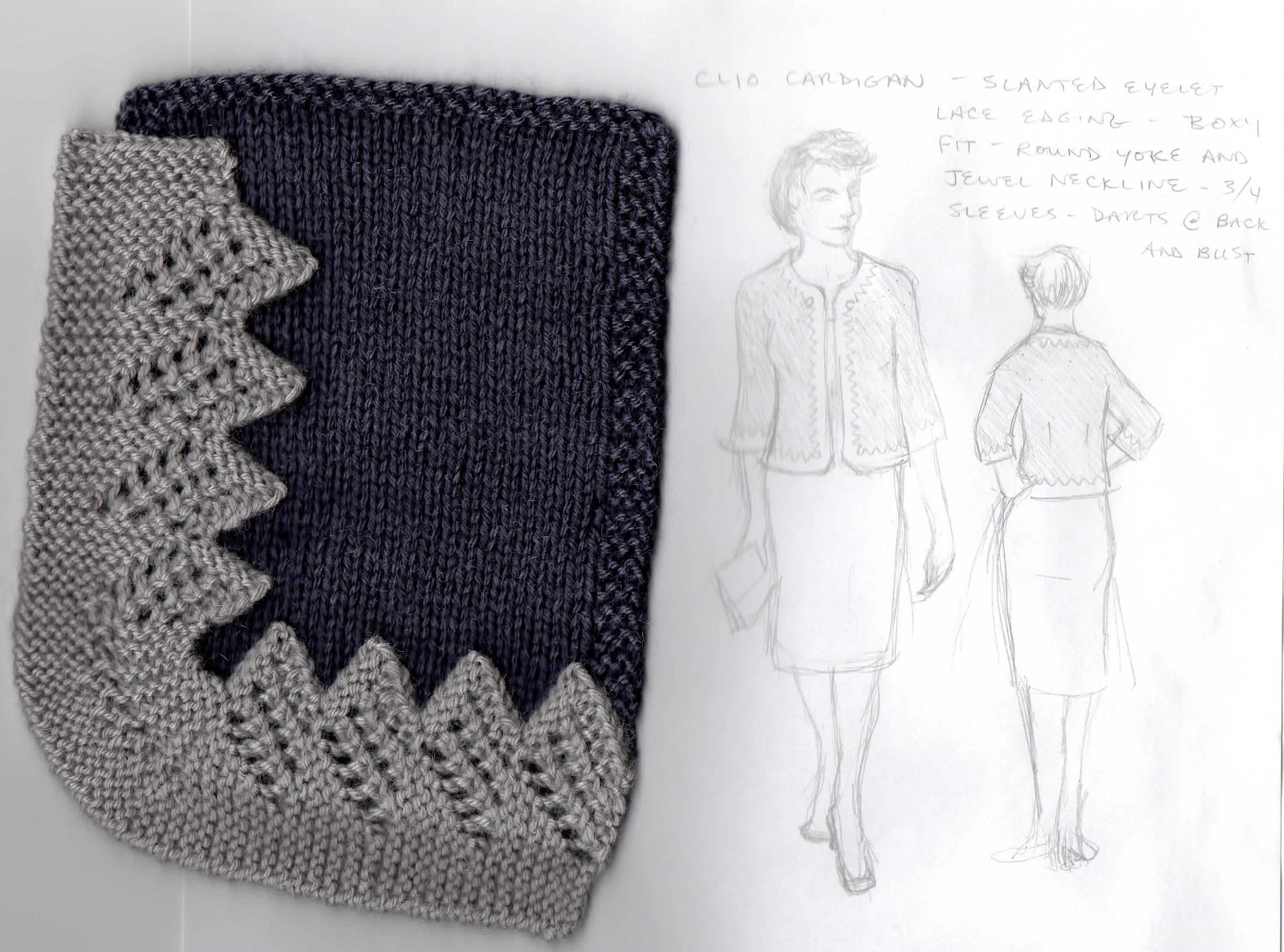
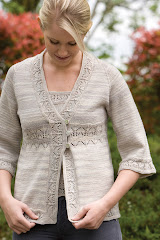
So even though I'd rather you DIDN'T buy it (buy the collection, so the whole Sock Report Volume One team wins!) here's my contribution: the Clio jacket, which is worked up in Lorna's Laces Sportmate. This color combo has a lovely Alice-in-Wonderland feel, and I think looks especially springy with the apple-green shirt they styled it with. It'd also look great with a sheath dress or a simple cami and a pencil skirt for work.


I thought a lot about color combinations when I was working this up--the prototype is actually a tone-on-tone mix of dark gray and silver, as you can see in this swatch and concept sketch. But I would love to see this design worked up with crisp navy trim on a white or cream ground, or in fire-engine red and a darker crimson or poppy red combo. Ooh, or what about celadon and jade green?


The yarn I swatched with is Knit Picks Gloss, which is a little finer than the Lorna's Laces Sportmate that final version ended up in, but still a sock yarn. Which leads me to my last point about how great The Sock Report is: It's about sock YARN, not just socks! I love, love, love the weight of yarn that's often sold as "sock yarn"--but I only like, like, like actually knitting socks with it. The Sock report, on the other hand, is a just a perfect mix of socks, shawls, scarves, gloves, and garments in fingering-weight or sport-weight yarn. It kind of reminds me of Marilyn Monroe trying on that tiara in "Gentlemen Prefer Blondes": "You DO wear it on your head! I just LOVE finding new places to wear diamonds!"

It also makes me really glad they didn't call it "The Fingering Report"...;-)