Thursday, June 5, 2014

Did I mention I went to Amsterdam?

Because I totally did! It was great, not least because of the fiber-craft scene there, which is small but vibrant. The impetus for this trip was the Orphan Film Symposium, which was being held overseas for the first time, at the EYE Film Institute, housed in a spectacular new building overlooking the Amsterdam waterfront. But I found plenty of ways to intertwine this trip with yarns, fabric, buttons, and knitting, of course!

More treasures from the Katten KabinetAs some of you may know, when I'm not knitting, I'm an audiovisual archivist. My specialty is the preservation of home movies and amateur film, and researching how those media have been integrated into our larger cultural heritage over the decades since their introduction. I'm a co-founder of the international Home Movie Day event and the nonprofit Center for Home Movies; my Billington Bag pattern is named for the current Librarian of Congress, and proceeds from sales benefit CHM and their efforts to preserve and provide access to amateur films from all over the world.

While these two sides of my identity may seem distinct, they're quite closely related. Home movies and handknits have lots in common: First off, there's the fact that they are both made of yards and yards of long skinny stuff, and they both have lots and lots of little tiny holes in them. They are also deeply personal, and highly reflective of the time and place they were made, not to mention the people who made them. They're often far more colorful than their mass-produced counterparts, and of course they're totally unique. With careful preservation, they can last for many years in pristine condition, but even when they're worn almost to tatters, they're still special.

It shouldn't come as a surprise, therefore, to hear that I wasn't the only person in the audience knitting my way through this symposium! One of my cherished colleagues, Catherine, had a lovely beaded shawl project going, and she was clicking away softly in the dark next to me while I worked on a baby blanket for my friends' son-in-progress. There was definitely at least one sock project in the works in that auditorium, too, but I didn't get a chance to ask the knitter about it--the program was jam-packed, as always, with amazing new discoveries, preservation premieres, rarities and one-of-a-kind productions, and there was hardly time to breathe during the meal breaks, let alone wolf down a delicious plateful of Indonesian food, before heading back into the theater for more screenings and talks.

Under the circumstances, I was truly glad that I'd built a couple of extra days into the trip earlier in the week--mostly to stave off jetlag, but also to ensure that I  had time to meet with my counterparts in the Presentation and Preservation of the Moving Image master's program at the University of Amsterdam...and to go yarn shopping, of course! Catherine was kind enough to show me the highlights of her city, and through her I met some truly lovely fellow-knitters. The night I arrived, I joined her at the Thursday-evening knit night hosted by charming LYS Penelope. Everyone there was lovely, wearing lovely things they'd knitted themselves, and they were all very much knitters after my own heart. Someone even baked a rhubarb cake to share with us, which was divine. (Since coming back, I've made that recipe twice...yum!)

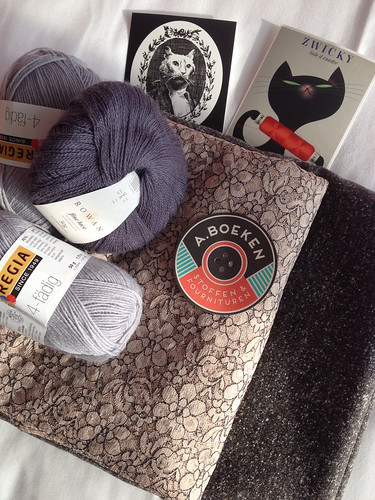
On the weekend, Catherine and I met up again to make the rounds of fabric, yarn, and button shops all over town via bike. The bicycle is the dominant form of life in Amsterdam, and the whole city is way more navigable on two wheels than four--a major, albeit very pleasant, change from auto-centric Los Angeles. I swear, I haven't ridden bikes with friends this much since I was ten years old! Although the cargo capacity of a rented three-speed cruiser (not to mention the ever-tighter restrictions on free checked baggage for international flights) puts a natural cap on shopping, and on the whole I was pretty restrained, I did manage to bring home a lovely haul. Behold!
image

One of our first stops was at A. Boeken, a stoffen and fournituren (fabric and notions) shop on Nieuwe Hoogstraat recommended by a lovely Raveler  in the Stitch 'n Bitch Amsterdam group (thanks for the tip, briocher!). Like many places in ancient, canal-crossed Amsterdam, this shop is taller than it is wide, but packed to the rafters with lovely things. I got several yards of re-embroidered lace and a dead classy three-season tweed in a color blend that's part charcoal, part coffee. Then we hit De Afstap on Oude Leliestraat, which has one of the best selections of Rowan yarns I've seen in a long time. Their prices were either really reasonable, or else I was doing the Euros-to-dollars math wrong; regardless, I scored some Rowan Fine Lace in a dusky violet and their last four balls of Regia 4-fadig in a pale silvery lavender color (which will go great with the browny tweed, whatever that becomes). We rounded out the expedition with a wander through the Albert Cuyp market, which has a handful of fabric shops, each with its own specialty: quilting cottons, decor, fashion fabrics, couture textiles, imported batiks. Finally, we browsed respectfully through the collection at the Knopenwinkel button shop, got some chocolate, and called it a day.

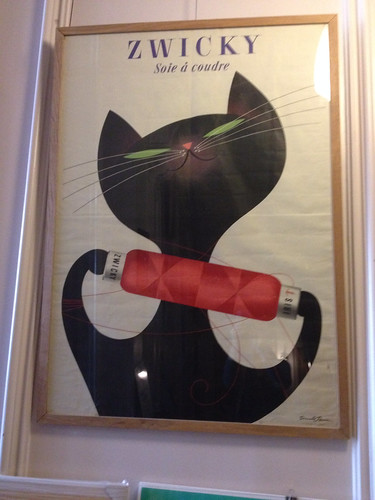
While I chose to leave the Anne Frank House for my next visit, I didn't neglect the great cultural treasures of the city. I made a dutiful pilgrimage to the Rijksmuseum and joined the massive crowds contemplating the equally-massive Rembrandt group portraits (but really preferred their decorative arts collection, which had some amazeballs cabinets inlaid with ivory and mother-of-pearl, and a surprisingly touching display of woolen hats found in the graves of ancient whalers).  Thanks to my Lonely Planet pocket guide, I also found my way to the Katten Kabinet, or Cat Museum! This is a private collection housed in one of the lavish homes on the Golden Bend. It's quirky, to say the least, and as you might imagine, yarn and cats playing with yarn are frequent motifs in the works on display here!
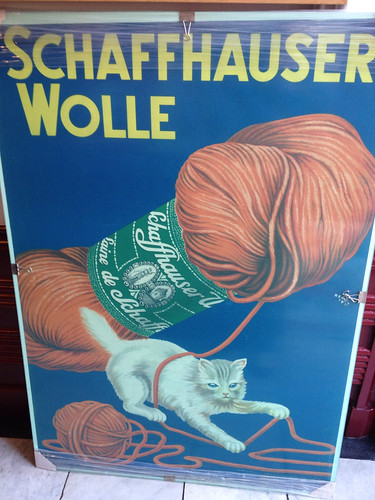
More treasures from the Katten Kabinet

There was one 17th-century genre painting of a cat with its paw caught in a steel trap, which was awfully disturbing, but the little bronze statuette of a cat pooping ("Poepende Kat" (1989) by Monica Rotgans) may well be my favorite piece of art ever.

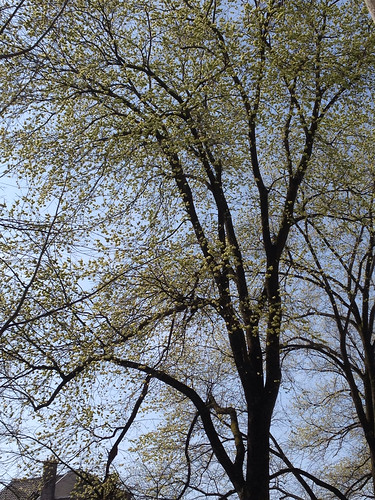
Every Dutch native I talked to there said the weather was unseasonably fine that week; I have no basis for comparison, this being my first trip to the country, let alone the city, but the sunshine and budding trees were indisputably pretty.
image

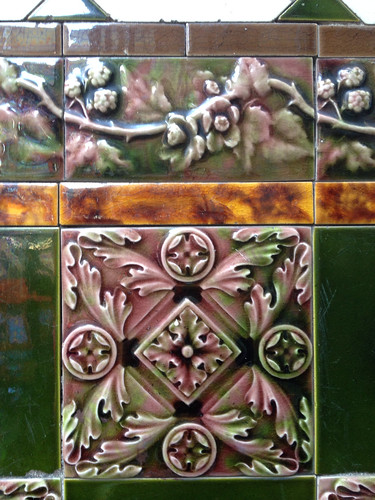
So, too, were the myriad architectural details of this old-world city: Antique tiles and delicate stonework abound there. You will miss a lot if you have to spend all your time there looking out for speeding bicycles, so be sure to take plenty of breaks for beers by the canal and people-watching if you go there yourself. And keep an eye out for me, too; I'm definitely going back at my earliest opportunity!
image


Thursday, May 29, 2014

Just released (finally!): Irma!

This is one of those designs that's been ALMOST ready to go for longer than I care to even think about. It's been waiting for those last few tweaks (pesky things like double-checking measurements and making schematics, which are my two least favorite parts of the technical editing process) for months and months and months on end. It's not all wasted time; in those same months, I've been field-testing (a.k.a. wearing all the time) the original prototypes, and have had a couple of friends test-knitting the original, non-schematic-ed, non-double-checked drafts and alerting me to minor errors and typos. And fortunately, the original photo shoot was done right around the same time of year as this, so maybe no one will look closely and see how many more crow's feet I have now. Without further ado, I give you... Irma!

CIMG2877


I attended a workshop with Deborah Newton at Vogue Knitting Live in LA a few years ago, which was well worth the price of admission. The fee included a copy of her then-new book Finishing School: A Master Class for Knitters, a welcome addition to my reference shelf, and Newton's own expertise and advice were invaluable! One of the many things I learned that week was that every knitter--young and old, experienced and novice--has their very own set of strongly held opinions about knitting, yarn, and everything associated with them. Deborah Newton, for instance, has near-religious convictions regarding seams in knitted garments--she's a big, big, big fan of 'em. In fact, she was so compelling on the subject of seams that I thought I'd go ahead and try designing a pieced-and-seamed cardigan myself, and Irma is it!

The Irma cardigan is a slightly airier, more feminine (if I can be gender-normative for a minute here) take on the shawl-collar sweaters all the hipster boys have traded their hoodies for as they've hit their mature (ha ha) years. It's worked in an allover columnar lace motif with deep ribbing at the cuffs and hem. And pockets, of course! I worked the original prototype, which is the jade green one shown above, in Simply Socks Yarn Company's solid wool/nylon "house blend." SSYC Solid is a yarn I really adore, not least for its springy plied texture, but also because it comes in, like, EVERY COLOR EVER. I also reknit the pattern, once it was (mostly) written, in Knit Picks Gloss Fingering in a dark gray color called Hawk. That yarn has a hint more luster and slightly crisper stitch definition, and makes the lace motif really pop. It also has an elegant drape in stockinette, thanks to its 30% silk blend, which helps the shawl collar roll while the button band lies splendidly flat, and that's why this yarn is another favorite of mine. (Yes, I have about forty-eleven different "favorite" yarns. Who doesn't?) Were I to make yet another one of these for myself--and I'm not ruling that out--I'd probably try a super-cozy and decadent winter version in Knit Picks Capretta, maybe in the Pesto colorway. But then, I'm a sucker for cashmere.

On the whole, I liked the seamed-garment experience. I learned to sew before I learned to knit, so on a fundamental level, the concept of taking flat pieces and building a garment out of them makes every bit as much sense to me as taking a strand of fiber and building it, stitch by stitch, row by row, into a shape that fits a body (or a hand, or a foot,  or what have you). For Irma, I used the crocheted-seam technique Newton demonstrated at the workshop and describes in her book; it was really fun to work, and I think I'll probably continue to use it for shoulder seams in preference to a three-needle bind-off. For one thing, it's easier to unwork and rework if you need to (if you've ever dismantled a thrift-shop sweater to recycle the yarn, you've probably already unworked a crocheted seam!). It also adds a skosh more structure to one part of a garment that really needs reinforcing, while still being flexible and elastic. And because it does use rather more yarn than a mattress-stitch seam or three-needle bind-off, you can even cannibalize it in a pinch if you need a foot or two of yarn to darn or patch a very well-worn garment. Unlike reserved leftover yarn, yarn transplanted from a seam will match the repaired area perfectly, since it's been laundered the same amount as the rest of the garment--so it's kind of a rainy-day account for your sweater! Which is good, because now that other people can actually knit this design for themselves, I'm halfway to wearing the prototpyes out.

Friday, May 2, 2014

Taking it down a notch

Sometimes you want a challenge; other times you just want things to be easy, and successful, and foolproof, and DONE. A Raveler posted a really good question recently on the pattern page for the Billington Bag:

Am I really the only one struggling to sew the darn lining? Maybe my interfacing is too stiff, but trying to fit the sides together is a nightmare. Rethinking the pattern to see if I can find a way to make the lining easier to sew.

You know what? I totally get it. The instructions for this design call for a pieced lining, where each of the four vertical sides is measured, shaped, and cut to conform really closely to the shape of the finished, felted bag.


Along with a good stiff interfacing, this pieced lining helps give the bag enough structure to stand open on its own, and prevents things like your car keys and cell phone from getting lost in folds of loose fabric. But it's a fussy process to sew corners and angles and seams on both sides of narrow strips of interfaced fabric, and dagnabit, there's just gotta be an easier way that gives ALMOST the same results, right? I think so--and here it is.

Instead of doing a pieced lining for the Billington Bag, knitters who want a shortcut to the finish line can try a modified sack lining. Three measurements, two pieces of fabric and matching interfacing, five seams (three of which are completely straight!), and you'll be ready to insert it.

Step 1: Measure.

Take your felted bag and flatten it out as shown below--so the top edges are even and the bottom of the bag is folded more or less in half along its long axis. Measure the width at the top of the bag (A), the width at the bottom of the bag (B), and the height from the top opening edge to the folded bottom edge (C).


Step 2: Cut.

Cut two rectangles of interfacing that measure B x C. Cut two rectangles of lining fabric that measure (B + 1") x (C + 1"). Center the interfacing on the lining fabric; you'll have 1/2" margins all the way around. Baste or tack interfacing in place on the wrong side of the fabric.

Step 3: Sew.

With right sides of fabric together, seam the two sides and the bottom closed, leaving the top open, like a pillowcase.

Subtract A from B; divide the remainder by 2, and mark a point that far in from the side of the interfacing on the top edge. (For instance, if your bottom width (B) is 14" and  top width (A) is 11", 14 - 11 = 3.  3 divided by 2 = 1.5, so you'll mark 1.5" in from the upper edge on both sides of the top.

If you're making the short version of the bag, fold it horizontally in thirds, and mark 1/3 of the way down on each side. Stitch a diagonal line from 1/3 down the side to the marked point on the upper edge, and trim away the excess, leaving 1/2" of lining fabric and trimming the interfacing very close to the stitching (1/8" or so). If you're making the tall version, do the same thing, but mark and stitch 1/4 of the way down the sides, instead of 1/3.

Now comes the tricky part (don't worry, it's not that tricky): Making the bottom of the lining flat! To do this, just put your hand inside the sack, down into one of the corners. Bring the side seam and the bottom seam together, pinching the corner flat. Sew straight across the flattened corner at the point where it's as wide as the inside bottom of your bag; repeat on the second side. (This is the same principle at work in paper grocery bags, so if you get lost and these caveman-level illustrations of mine are no help, take a look at the bottom of one of those!)
Step 4: Finish.

Tuck the triangular points under the bottom and tack in place, if you like (or just press them with under gently with an iron). Turn the upper edge of the lining fabric over the interfacing, insert the lining, and stitch to the upper edge of the bag. Done!

Monday, December 30, 2013

Tillie baby blanket

What do you know? It's baby season again. A colleague just announced her pregnancy, and I have two other friends with a bun in the proverbial oven now. Time to fire up the ol' baby-knitting engine and get some gifts in the works before the showers hit!

Luckily, I just finished writing up a pattern from the LAST baby avalanche I went through, in which a bunch of the expectant parents opted to find out the baby's gender on the day of delivery. While I totally respect the decision--and even admire it, as I wouldn't have the willpower to resist finding out--it does throw a bit of a wrench in the works when it comes to almost any kind of baby gift. I am seeing that there is NOT a lot of gender-neutral stuff out there past the plain white onesie. Even the items that come in yellow or pale green (which are apparently, and respectively, the classic and contemporary code colors for gender-nonspecific baby gear) tend to have some coded gender references. You know, ladybugs or lizards, that kind of shit.

Knitting patterns aren't much better, although the silhouettes are at least more non-aligned. Where you hit the wall with those is in the baby-yarns section of the LYS, which just looks like Tinkerbell's toilet to me. LOTTA pastels on that wall, folks. Don't babies need basic black and classic navy too? Or, you know, teal and tangerine and deep, rich earth tones?

If anyone knows a better way to style a baby blanket than draping it on a chair, please tell me.

I'm not saying I've totally solved these problems, but along with the Peabey Bear stuffed animal (which is nice because it's soft and baby-safe, especially if you knit it up in and stuff it with organic cotton) the Tillie Blanket pattern is my stab at it. It's got a bit of eyelet texture, so it's not so boring to knit, and there's a subtle flounce at the edge, yet the overall effect is not so lacy and ruffly as to be categorically girly-girly. It works just as well in blue or pink as it would in yellow or soft green; I opted for a nice sandy neutral, which should go with pretty much anything (but coordinates especially well with burp stains). It's worked up in an easy-care sport-weight yarn that comes in a wide range of colors--including a fabulous tangerine orange, rich red, chocolate-y brown, and yes, basic black, if the baby in question has a daring fashion sense or artsy parents who would go for that. No more waiting 'till the baby comes out to cast on and start knitting!


Monday, December 23, 2013

Christmas blues!

Dear Santa,

It's great that you came early this year with a set of those new Caspian interchangeable needle tips from Knit Picks, because I'm still clinging to the idea that I might fulfill my New Year's resolution to seriously bust some stash in 2013. New needles are going to be just the thing to help me settle in with a few pounds of wool and all ninety-one hours of the Lord of the Rings trilogy and crank out stuff for everyone's stockings before the clock runs out on my promise to myself!

I really am absurdly pleased by these babies. Something non-knitters, or new knitters, often find surprising is the intensely personal--and contingent--nature of one's choice of needles. (Actually, what non-knitters seem to find most surprising that there is more than one kind, since point sticks are pointy sticks, right? I can't tell you the number of times I've been knitting in public on circulars and seen that puzzled look on someone's face that comes immediately before they ask, "What does that string in between the sticks do?")

(Image from WoolFreeandLovinKnit--thx!)

Me, I've been through 'em all, practically. As a kid, I first learned on the kind of metal-capped, size 8, pastel-coral-colored plastic straights that look so nice arranged in an antique jug in your sun-drenched craft studio. I knitted on and off throughout my teens and twenties, mostly with a few pairs of hand-me-down plastic circulars from my mom's 70's-era collection (possibly Bryspun, but I've never been able to verify that conclusively). I didn't know anything about gauge and was pretty cavalier about things like fit and finish, so the results weren't always great, but at the time I did like the way they felt in my hands--springy, with nice sharp tips that slid neatly in and out of the stitches. The plastic finish was smooth, but not so much so that the needles were always slipping out of the live stitches at inopportune moments or during transit.

When I got more serious about knitting in my late twenties and early thirties, I discovered that gauge was a thing, and that you actually get better results when you use the right size needles (see, kids? College, graduate school, and then more graduate school really do make you smarter!). So I started buying needles as needed for various projects: Lantern Moon ebony circulars, Chiao Goo bamboo dpns, the odd pair of Addi Turbos. I developed a wee obsession with Brittany birch dpns for a while there--I liked that there were five in each set, instead of four (having lost a couple of those extra needles to cat-chewing incidents over the years) and the smooth blond wood spoke to me, especially in the shorter lengths they offered. But I will freely admit that for a long time I was a promiscuous knitter--I'd still go with just about anything that came to hand, and my needle library was a real hodgepodge of different brands, styles, and sizes. Given the only common feature, which was that they were mostly sizes 4-6 (with just the occasional 8 or 9), you really could say I knitted like I dated...

So perhaps it's no coincidence that when I moved to Texas in 2006 with my new husband, I was finally ready to settle down with one kind of needle, the one that was just right for this here Goldilocks. Turns out the Knit Picks Options interchangeable tips in the Harmony wood finish was THE NEEDLE FOR ME. Other Harmony knitters will know exactly why: Super-pointy tips; smooth but still toothy finish on the wood; fine, flexible cables with unobtrusive joins; very reasonable price point. The only thing I didn't love about these needles was that they were...purple.  I don't hate the color; obviously, it's not a dealbreaker, since I've been knitting happily on these needles for years now. I have a plum-colored dress I quite like, and a dusty lilac one, too. But I'm not really a purple person, and deep down in my heart, I confess, I have wished for these needles to be a different color. (Different, that is, from any of the OTHER three finish options these needles come in, which include a nickel-finish metal, Zephyr clear acrylic, and Sunstruck blond-wood laminate, none of which are so much better than the original purple for my purposes that I've felt it worth switching...perhaps since they all come with the signature purple cable.)

Lo and behold, they come out with these Caspian needles! They're a beautiful peacock-tail blend of blues and greens, with lovely deep-teal cables. I heart them so much; they're just what I've been wishing for all these years. To paraphrase Dean Martin: Santa may have brought you some stars for your shoes, but Knit Picks kindly gave me the blues...the ocean-colored, emerald-cabled Caspian blues.

I'll be wishing all of you the best for a warm and joyous holiday season, and for a bright and bountiful year to come!

Wednesday, December 4, 2013

Winter Bride

Thanks for checking in--I'm back, and with a new pattern, too! Winter Bride Gloves just went up on Ravelry, and is perfect for your holiday giving projects (fancy! but easier than they look) as well as any New Year's nuptials to which you might be invited (buttercream frosting will blend right in on these babies).

I've missed knitting, but putting together a new pattern was fun, and I'm really pleased with how these turned out. It's almost enough to make all those false starts from the last year feel more like sketches than failures. (A recent home-office clean-up effort ended with me surrounded by a pile of half-finished and aborted and unraveling attempts at all kinds of things, in tears and feeling like they were a self-portrait of the artist as a young fuck-up...and honestly, I'm not even that young!) With luck, these will be the first little flurries that turn into a proper snowstorm of creativity. Watch this space!

Wednesday, May 15, 2013

Players gonna play, ballers gonna ball.

You know what? It's been a tough couple of months. We finally said goodbye to our sick kitty at the end of April (see previous post), I've been making little headway on my dissertation, my Myrtle cardigan went through the wash and came out with a gaping hole that seems to have unraveled from a dropped stitch...

Ruh-roh!

And the cherry on top of the dog-poop sundae? This weekend saw the return, once again, of some dissatisfied customers who periodically post nasty comments about one of my patterns on Ravelry. Now, I know I'm not perfect, and neither are my patterns--errors, omissions, and just plain bad writing can and will make it through even the most rigorous tech-editing and test-knitting protocols, and this was an early release for me, so my protocols weren't the best then--but I make an effort. And these are people A) whom I did make an honest and strenuous effort to assist, B) most of whose problems I was unable to replicate myself, and C) to whom I not only apologized, repeatedly and sincerely, and gave a full refund of their purchase price, but ALSO offered their choice of a different pattern from my own store, or any pattern from their own Ravelry queue, as a gift, by way of apology for the inconvenience.

A reasonable person might consider our business concluded with that refund. But still, going on two years after their initial complaint to me, a couple of them will periodically log on to Ravelry and post afresh on the pattern page, calling the pattern unworkable and me unethical, a fraud, an unhelpful person, etc. I delete these comments as soon as I'm notified about them, which only seems to make them angrier. The content of the comments now has as much to do with the fact that I deleted their previous comments (and am therefore unscrupulous, amoral, and foolishly loath to peacefully accept their well-intended defamation) as it does with the fact that they had trouble knitting the pattern. (I should note, and you'll have to take my word for it, that these are the only comments I've ever deleted from a pattern page.) For what it's worth, I'll respond personally or publicly (depending on the situation) to Ravelry forum posts that are critical in nature. I'll even reach out to someone personally if their project notes indicate that they encountered a problem or error that they didn't convey to me directly, thanking them for the heads-up and letting them know if, for instance, a new version has been released with a corresponding correction. But my very strong feeling is that I'm not morally obliged to allow anyone to defame me in my own (virtual) store, and no unhappy customer is morally obliged to tell all potential purchasers of the pattern know they had issues with it and/or me. Especially after they've gotten their money back! Or, to put it most succinctly:

Embroidery project
One reason this phrase has such power is that it speaks to the fundamental vulnerability required of everyone who does something creative. If you publish, perform, work collaboratively or in teams, or otherwise live out loud, you're inevitably going to hear from some haters. Much as I'd like to say I've learned to rise above it like Princess Pony galloping across the rainbow to Glittertown, that vulnerability can be really crippling. The haters speak much louder than the lovers in the ol' interior monologue, even though the lovers almost always outnumber the haters.

Worse yet, the hate of the haters is infectious. A very talented friend recently asked me about starting to publish her own designs, and the first draft of my response to her was a real shit sandwich: Your ideas are great! You should definitely give publishing them a try! People are going to be totally crappy to you, of course, and you'll spend most of your time dealing with inane tech-support questions, especially for the patterns you give away for free, and still other people will pretend the Internet exists solely so they can revive the petty tyrannies of middle school and make fun of you for making your own clothes. But totally, you should put your beautiful and inspired work out there!' It'll be super-fulfilling, except for when it makes you want to die inside! Although I think I managed to make it somewhat more encouraging of her wonderful talent and potential, and much less about my personal experiences and insecurities, I'm ashamed of how much of the latter made it into the final response that I eventually did send her.

So do me a favor, everyone out there: While I take crochet hook in hand and set to mending my messed-up Myrtle, take a minute today to send someone--whether you know them or not--a wholly positive, wholly unsolicited compliment on their creative work. Or write a nice thank-you note to someone. Give a penny instead of taking one (or instead of putting your two cents in, if they're two picky cents). Above all, don't hate! There's already plenty of that going around.